

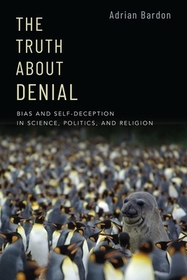
The Truth About Denial
Bias and Self-Deception in Science, Politics, and Religion
- Publisher's listprice GBP 27.49
-
12 411 Ft (11 820 Ft + 5% VAT)
The price is estimated because at the time of ordering we do not know what conversion rates will apply to HUF / product currency when the book arrives. In case HUF is weaker, the price increases slightly, in case HUF is stronger, the price goes lower slightly.
- Discount 20% (cc. 2 482 Ft off)
- Discounted price 9 929 Ft (9 456 Ft + 5% VAT)
- Discount is valid until: 30 June 2026
Subcribe now and take benefit of a favourable price.
Subscribe
12 411 Ft

Availability
Estimated delivery time: In stock at the publisher, but not at Prospero's office. Delivery time approx. 3-5 weeks.
Not in stock at Prospero.
Why don't you give exact delivery time?
Delivery time is estimated on our previous experiences. We give estimations only, because we order from outside Hungary, and the delivery time mainly depends on how quickly the publisher supplies the book. Faster or slower deliveries both happen, but we do our best to supply as quickly as possible.
Product details:
- Publisher OUP USA
- Date of Publication 9 October 2019
- ISBN 9780190062279
- Binding Paperback
- No. of pages352 pages
- Size 140x206x22 mm
- Weight 408 g
- Language English 0
Categories
Short description:
This volume is a wide-ranging examination of denial and ideological denialism. It offers a readable overview of the psychology and social science of bias, self-deception, and denial, and examines the role of ideological denialism in conflicts over science and public policy, politics, and culture.
MoreLong description:
This is an open access title available under the terms of a CC BY-NC-ND 4.0 International license. It is free to read at Oxford Scholarship Online and offered as a free PDF download from OUP and selected open access locations.
People believe what they want to believe. It is a striking-yet all too familiar-fact about human beings that our belief-forming processes can be so distorted by fears, desires, and prejudices that an otherwise sensible person may sincerely uphold a false claim about the world despite overwhelming evidence to the contrary. When we describe someone as being "in denial," we mean that he or she is personally threatened by some set of facts and consequently fails to assess the situation properly according to the evidence, instead arguing and interpreting evidence in light of a pre-established conclusion.
In a world polarized over politics, culture, race, and religion, it is evident that ideological commitments can influence one's perception of reality in socially destructive ways, especially when one perceives a threat to these commitments. When group interests, creeds, or dogmas are threatened by unwelcome factual information, biased thinking can become ideological denialism. This is a problem that affects everybody: Whereas denial can interfere with individual well-being, ideological denialism can stand in the way of urgent advancements in public policy.
This book offers an accessible, historically and scientifically informed overview of our understanding of denial and denialism. Adrian Bardon introduces the reader to the latest developments in the interdisciplinary study of denial, and then investigates the role of human psychology and ideology in, respectively, science denial, economic policy, and religious belief.
The Truth About Denial is an exceptional book
Table of Contents:
Acknowledgements
Preface
Chapter One: Bias and Belief
1. What is denial?
2. "Hot cognition"
3. Mechanisms of motivated reasoning
4. The origins of denial
5. Pathological ideology, and denialism as a social phenomenon
Chapter Two: Science Denial
1. Climate science denial
2. Personality, system, and status quo
3. The asymmetry thesis
4. Science and societal change
Chapter Three: Pride, Prejudice, and Political Economy
1. Political economics
2. Poverty and the fundamental attribution error
3. Classism and racial stereotyping
4. The liberty argument
Chapter Four: Religion
1. Reasons to believe
2. Is it even a belief?
3. The origins of religiosity
4. Tenacity
5. The problem(s) with religion
Afterword: Directions for Science Communication
1. More information?
2. Message framing and delivery
References

