

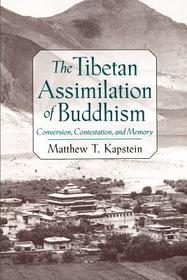
The Tibetan Assimilation of Buddhism
Conversion, Contestation, and Memory
- Publisher's listprice GBP 48.99
-
22 118 Ft (21 065 Ft + 5% VAT)
The price is estimated because at the time of ordering we do not know what conversion rates will apply to HUF / product currency when the book arrives. In case HUF is weaker, the price increases slightly, in case HUF is stronger, the price goes lower slightly.
- Discount 10% (cc. 2 212 Ft off)
- Discounted price 19 906 Ft (18 959 Ft + 5% VAT)
Subcribe now and take benefit of a favourable price.
Subscribe
22 118 Ft

Availability
printed on demand
Why don't you give exact delivery time?
Delivery time is estimated on our previous experiences. We give estimations only, because we order from outside Hungary, and the delivery time mainly depends on how quickly the publisher supplies the book. Faster or slower deliveries both happen, but we do our best to supply as quickly as possible.
Product details:
- Publisher OUP USA
- Date of Publication 21 February 2002
- ISBN 9780195152272
- Binding Paperback
- No. of pages336 pages
- Size 225x168x18 mm
- Weight 463 g
- Language English
- Illustrations 14 halftones 0
Categories
Short description:
Thanks to the international celebrity of the present Dalai Lama, Tibetan Buddhism is attracting more attention than at any time in its history. Although there have been numerous specialist studies of individual Tibetan texts, however, no scholarly work has as yet done justice to the rich variety of types of Tibetan discourse. This book fills this lacuna, bringing to bear the best methodological insights of the contemporary human sciences, and at the same time conveying to non-specialist readers an impression of the broad domain of Tibetan religious and philosophical thought. Ranging widely over the immense corpus of Tibetan literature, Kapstein brilliantly illuminates many of the distinctive Tibetan contributions and points out some of the insights.
MoreLong description:
Thanks to the international celebrity of the present Dalai Lama, Tibetan Buddhism is attracting more attention than at any time in its history. Although there have been numerous specialist studies of individual Tibetan texts, however, no scholarly work has as yet done justice to the rich variety of types of Tibetan discourse. This book fills this lacuna, bringing to bear the best methodological insights of the contemporary human sciences, and at the same time conveying to non-specialist readers an impression of the broad domain of Tibetan religious and philosophical thought.
For over a millenium a Tibetan Buddhist intelligentsia produced a vast literature in which they explored the legacy of Indian (and to a lesser extent Chinese) Buddhism, often with exceptional rigor and creativity. At the same time, they also articulated perspectives and raised questions that reflected a distinctly Tibetan heritage, above and beyond the impetus derived from foreign sources. The views they generated, Kapstein shows, were often strikingly original. Despite the traditional insistence on the preeminence of the Indian tradition, therefore, the Tibetan transformation of Buddhist discourse is worthy of study in its own right. Ranging widely over the immense corpus of Tibetan literature, Kapstein brilliantly illuminates many of the distinctive Tibetan contributions and points out some of the significant sources of Tibetan Buddhism's historical dynamism.

