

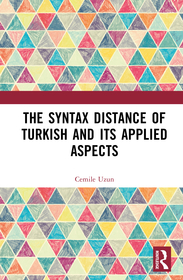
The Syntax Distance of Turkish and Its Applied Aspects
- Publisher's listprice GBP 155.00
-
69 982 Ft (66 650 Ft + 5% VAT)
The price is estimated because at the time of ordering we do not know what conversion rates will apply to HUF / product currency when the book arrives. In case HUF is weaker, the price increases slightly, in case HUF is stronger, the price goes lower slightly.
- Discount 20% (cc. 13 996 Ft off)
- Discounted price 55 986 Ft (53 320 Ft + 5% VAT)
- Discount is valid until: 30 June 2026
Subcribe now and take benefit of a favourable price.
Subscribe
62 984 Ft

Availability
Not yet published.
Why don't you give exact delivery time?
Delivery time is estimated on our previous experiences. We give estimations only, because we order from outside Hungary, and the delivery time mainly depends on how quickly the publisher supplies the book. Faster or slower deliveries both happen, but we do our best to supply as quickly as possible.
Product details:
- Edition number 1
- Publisher Routledge
- Date of Publication 3 July 2026
- ISBN 9781041162636
- Binding Hardback
- No. of pages194 pages
- Size 234x156 mm
- Language English
- Illustrations 59 Illustrations, black & white; 59 Halftones, black & white; 22 Tables, black & white 700
Categories
Short description:
This book offers a comprehensive examination of the syntactic structures of Turkish across its historical periods, from Old Turkish to Chagatai Turkish. It serves as an important resource for Turkologists and historical linguists, researchers in computational linguistics, language typology, and cognitive linguistics.
MoreLong description:
This book offers a comprehensive examination of the syntactic structures of Turkish across its historical periods, from Old Turkish to Chagatai Turkish. Moving beyond traditional descriptive approaches, it applies dependency grammar and quantitative methods to reveal structural variation and diachronic change.
Drawing on carefully prepared corpora representing seven key stages of Turkish, the analysis addresses measures such as syntactic distance, nucleus–actant relations, bridge–node ratios, and structural centrality. Through computational models and natural language processing tools, it provides a systematic profile of how Turkish sentence structures have evolved over time. This perspective highlights not only formal and functional aspects but also the communicative and narrative needs that shaped expression in different periods.
The book sheds light on the formal and functional dimensions of Turkish syntax and builds a bridge between theoretical linguistics and the digital humanities. By introducing the GSM-4 model, it offers a reproducible framework for measuring syntactic complexity in historical texts. In this respect, the volume serves as an important resource not only for Turkologists and historical linguists but also for researchers in computational linguistics, language typology, and cognitive linguistics.
MoreTable of Contents:
Preface
Chapter 1. Introduction
Chapter 2. Dependency Grammar: Theoretical Foundations
Chapter 3. Methodology
Chapter 4. Findings
Chapter 5. Conclusion
Chapter 6. GSM-4 model Proposal
Index
More
