

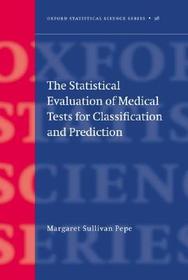
The Statistical Evaluation of Medical Tests for Classification and Prediction
Series: Oxford Statistical Science Series; 28;
- Publisher's listprice GBP 212.50
-
101 521 Ft (96 687 Ft + 5% VAT)
The price is estimated because at the time of ordering we do not know what conversion rates will apply to HUF / product currency when the book arrives. In case HUF is weaker, the price increases slightly, in case HUF is stronger, the price goes lower slightly.
- Discount 10% (cc. 10 152 Ft off)
- Discounted price 91 369 Ft (87 018 Ft + 5% VAT)
Subcribe now and take benefit of a favourable price.
Subscribe
101 521 Ft

Availability
printed on demand
Why don't you give exact delivery time?
Delivery time is estimated on our previous experiences. We give estimations only, because we order from outside Hungary, and the delivery time mainly depends on how quickly the publisher supplies the book. Faster or slower deliveries both happen, but we do our best to supply as quickly as possible.
Product details:
- Publisher OUP Oxford
- Date of Publication 13 March 2003
- ISBN 9780198509844
- Binding Hardback
- No. of pages318 pages
- Size 241x160x21 mm
- Weight 592 g
- Language English
- Illustrations numerous figures 0
Categories
Short description:
This book describes statistical techniques for the design and evaluation of research studies on medical diagnostic tests, screening tests, biomarkers and new technologies for classification and prediction in medicine.
MoreLong description:
The use of clinical and laboratory information to detect conditions and predict patient outcomes is a mainstay of medical practice. Modern biotechnology offers increasing potential to develop sophisticated tests for these purposes. This book describes the statistical concepts and techniques for evaluating the accuracy of medical tests. Worked examples include applications to cancer biomarker studies, prospective disease screening studies, diagnostic radiology studies and audiology testing studies. The statistical methodology can be broadly applied for evaluating classifiers and to problems beyond medical settings.
Several measures for quantifying test accuracy are described including the Receiver Operating Characteristic Curve. Pepe presents statistical procedures for the estimation and comparison of those measures among tests. Regression frameworks for assessing factors that influence test accuracy and for comparing tests while adjusting for such factors are presented. The sequence of research steps involved in the development of a test is considered in some detail. Sample size calculations and other issues pertinent to study design are described for tests at various phases of development. In addition, the impacts of missing data and imperfect reference data are addressed. These problems often occur in practice, and modern statistical procedures for dealing with them are discussed. Additional topics that are covered include: meta-analysis for summarizing the results of multiple studies of a test; the evaluation of markers for predicting event time data; and procedures for combining the results of multiple tests to improve classification.
This book should be of interest to quantitative researchers and practicing statisticians. The book also covers the theoretical foundations for statistical inference and should therefore be of interest to academic statisticians including those involved in statistical methodological research in this field.
It is a clear and authorative work which will be invaluable for anyone trying to establish a new diagnostic test.
Table of Contents:
Introduction
Measures of Accuracy for Binary Tests
Comparing Binary Tests and Regression Analysis
The Receiver Operating Characteristic Curve
Estimating the ROC Curve
Covariate Effects on Continuous and Ordinal Tests
Incomplete Data and Imperfect Reference Tests
Study Design and Hypothesis Testing
More Topics and Conclusions
References/Bibliography
Index

