

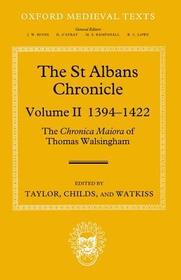
The St Albans Chronicle
The Chronica maiora of Thomas Walsingham: Volume II 1394-1422
Series: Oxford Medieval Texts;
- Publisher's listprice GBP 332.50
-
150 123 Ft (142 975 Ft + 5% VAT)
The price is estimated because at the time of ordering we do not know what conversion rates will apply to HUF / product currency when the book arrives. In case HUF is weaker, the price increases slightly, in case HUF is stronger, the price goes lower slightly.
- Discount 10% (cc. 15 012 Ft off)
- Discounted price 135 111 Ft (128 678 Ft + 5% VAT)
Subcribe now and take benefit of a favourable price.
Subscribe
150 123 Ft

Availability
printed on demand
Why don't you give exact delivery time?
Delivery time is estimated on our previous experiences. We give estimations only, because we order from outside Hungary, and the delivery time mainly depends on how quickly the publisher supplies the book. Faster or slower deliveries both happen, but we do our best to supply as quickly as possible.
Product details:
- Publisher OUP Oxford
- Date of Publication 23 June 2011
- ISBN 9780199253463
- Binding Hardback
- No. of pages992 pages
- Size 217x139x58 mm
- Weight 1336 g
- Language English 90
Categories
Short description:
Thomas Walsingham has been described as the last of the great medieval chroniclers, and his St Albans Chronicle is arguably the most important account of English history to be written at this time. This is the first modern edition, and it provides a facing-page English translation, substantial historical commentary, and textual notes.
MoreLong description:
Thomas Walsingham, a monk of St Albans, has been described as the last of the great medieval chroniclers. His major work, the Chronica maiora, covers the years 1376-1422, and is arguably the most important account of English history to be written in England at this time. Walsingham's text has never been published as a continuous whole. It is found in no fewer than three separate publications in the Rolls Series, and was printed from manuscripts whose exact identity was not then clearly understood. The nature of the Rolls Series publications, and the different versions of the chronicle have raised questions concerning the relationship of the various manuscripts of the Chronica maiora, and also of Walsingham's own involvement with the text. In this new edition these problems are considered and the Chronica maiora is shown to be predominantly the work of one man, Thomas Walsingham.
Volume II of the St Albans Chronicle (1394-1422) now completes the edition. Drawing on the text in Bodley 462 and confirming the work of V. H. Galbraith, the editors make clear that the Annales Ricardi Secundi et Henrici Quarti (regarded in the Rolls Series as a separate chronicle) were an integral part of the Chronica maiora. They also argue that, while Walsingham's contribution as author in the later years was much smaller than in the years to 1393 (when he was without doubt the sole author), it is most likely that he supervised the whole work; and at times, as in the vivid and dramatic descriptions of the battles of Shrewsbury and of Agincourt, his own style is again apparent.
The chronicle is of the greatest historical value for Richard II's last years and for his deposition and the accession of Henry IV. It is wholly in favour of the Lancastrian revolution of 1399 and remains 'Lancastrian' in tone to its end. It illustrates (with sympathy) Henry's difficulties in establishing the dynasty and includes unique material on his relations with his son. For Henry V's reign it provides valuable details of his Norman campaigns. Over both reigns St Albans' hatred of Lollardy and its interest in the healing of the Great Schism are apparent in the coverage given them. In the later years, the extent of the commentary on events decreases, but the information available at St Albans and written here continues to be of a high order. The chronicle remains absorbing right to its end.
Decades of learning have gone into the production of this edition of Walsingham's chronicle ... [Leslie] has produced a very readable and accurate translation of what is occasionally a difficult text. Indeed, it is hard to fault this edition: the introduction is clear and detailed, the footnotes are extensively researched and always helpful, and the production of the volume matches the high standards to be expected from Oxford Medieval Texts. This combined expertise has produced what will surely become the standard edition of this marvellous chronicle.
Table of Contents:
Introduction
Text and Translation
Appendices
Indexes

