

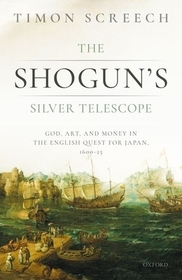
The Shogun's Silver Telescope
God, Art, and Money in the English Quest for Japan, 1600-1625
- Publisher's listprice GBP 39.99
-
18 055 Ft (17 195 Ft + 5% VAT)
The price is estimated because at the time of ordering we do not know what conversion rates will apply to HUF / product currency when the book arrives. In case HUF is weaker, the price increases slightly, in case HUF is stronger, the price goes lower slightly.
- Discount 10% (cc. 1 806 Ft off)
- Discounted price 16 249 Ft (15 476 Ft + 5% VAT)
Subcribe now and take benefit of a favourable price.
Subscribe
18 055 Ft

Availability
printed on demand
Why don't you give exact delivery time?
Delivery time is estimated on our previous experiences. We give estimations only, because we order from outside Hungary, and the delivery time mainly depends on how quickly the publisher supplies the book. Faster or slower deliveries both happen, but we do our best to supply as quickly as possible.
Product details:
- Publisher OUP Oxford
- Date of Publication 14 October 2020
- ISBN 9780198832034
- Binding Hardback
- No. of pages326 pages
- Size 235x164x20 mm
- Weight 640 g
- Language English
- Illustrations 37 illustrations 29
Categories
Short description:
The story of two extraordinary gifts from King James I of England to the Shogun of Japan - and what this tells us about says about the seventeenth century England from which they came and the quizzical Asian rulers to whom they were given.
MoreLong description:
The East India Company, founded in London in 1600, was the world's biggest trading organization until the twentieth century. It was originally a spice trading organization, and its existence was precarious in its early years. But its governors soon began to think bigger. A decade after its foundation, they started to plan voyages to more adventurous places, notably Japan. Japan had silver, was cold in winter, and had no sheep, so was a perfect market for England's main export, woollen cloth. The Company planned to add to its spice-runs, sailing back and forth to Japan, exchanging wool for silver. This could be done quickly and easily, over the top of Russia - or so the maps of the day suggested (these same maps also showed Japan twenty times too large, about the size of India).
Knowing the Spanish and Portuguese had got there before them, the Company prepared a special present to impress and win over their Japanese hosts. They chose as their first gift a silver telescope. The expedition carrying the telescope departed in 1611, and the Shogun was finally presented with the telescope in the name of King James I in 1613. It was the first telescope ever to leave Europe, and the first made as a presentation item. Before this voyage had even returned, the Company had dispatched another with an equally stunning cargo: nearly a hundred oil paintings.
This is the story of these two extraordinary cargoes: what they meant for the fortunes of the Company, what the choice of them says about the seventeenth century England from which they came, and what effect they had on the quizzical Asian rulers to whom they were given.
The Shogun's Silver Telescope opens up new avenues of research
Table of Contents:
Acknowledgments
Note on Money
Chronology
The Company, the Spice Trade, and Japan
Preparing London
Sending the Telescope
The Cargo of the New Year's Gift
Japan and Back
The English Factory in Japan
The Cargo of the New Year's Gift in Japan
The Company Must Decide
Appendix: List of Company Voyages
Notes
Bibliography

