

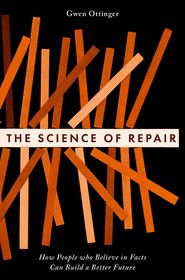
The Science of Repair
How People who Believe in Facts Can Build a Better Future
- Publisher's listprice GBP 22.99
-
10 379 Ft (9 885 Ft + 5% VAT)
The price is estimated because at the time of ordering we do not know what conversion rates will apply to HUF / product currency when the book arrives. In case HUF is weaker, the price increases slightly, in case HUF is stronger, the price goes lower slightly.
- Discount 10% (cc. 1 038 Ft off)
- Discounted price 9 341 Ft (8 897 Ft + 5% VAT)
Subcribe now and take benefit of a favourable price.
Subscribe
10 379 Ft

Availability
Estimated delivery time: In stock at the publisher, but not at Prospero's office. Delivery time approx. 3-5 weeks.
Not in stock at Prospero.
Why don't you give exact delivery time?
Delivery time is estimated on our previous experiences. We give estimations only, because we order from outside Hungary, and the delivery time mainly depends on how quickly the publisher supplies the book. Faster or slower deliveries both happen, but we do our best to supply as quickly as possible.
Product details:
- Publisher OUP USA
- Date of Publication 23 April 2026
- ISBN 9780197769867
- Binding Hardback
- No. of pages208 pages
- Size 241x167x20 mm
- Weight 440 g
- Language English 681
Categories
Short description:
In The Science of Repair, Gwen Ottinger clarifies the role that research plays in combatting injustice and how it can be reparative. Examining the thirty-year history of communities' efforts to measure oil refinery emissions in the air they breathe, the author chronicles compelling ethnographies that have made restorative EJ possible. Taken together, these stories present innovative ideas for how researchers can pursue new knowledge and social justice in more integrated and effective ways. The book also discusses the shortcomings of EJ efforts, urging justice-conscious researchers to experiment with new strategies for making their science more fully reparative.
MoreLong description:
A transformative account of the role science can play in combatting injustice--by deepening our moral commitments to each other through collaborative investigation.
For many people, science and social justice seem to be natural allies-the slogan "science is real" often accompanies affirmations of diversity and reproductive rights. In practice, too, doing science is an increasingly prevalent strategy of social and environmental justice movements. But while it seems apparent that science can aid in the pursuit of justice, it can be hard to explain how it does so-and thus hard to know how to deploy science most strategically.
In The Science of Repair, Gwen Ottinger draws on years of on-the-ground research to offer a much-needed explanation of how science works to combat injustice. Telling the stories of ordinary people who've turned to science in the hopes of reducing toxic pollution in their communities, the scientists and innovators who've developed methods to enable communities to better represent their experiences, and the charismatic technologies that they've deployed, Ottinger presents a surprising conclusion: proving that people have been harmed, in itself, rarely advances justice. The process of investigating injustice, on the other hand, can strengthen shared standards for right and wrong, increase ordinary people's ability to hold powerful actors accountable, and bolster hope that wrongs will be redressed-all essential elements of a just society.
For those who believe that science should matter to public discourse and decision-making, Gwen Ottinger's engaging new work offers clear steps to help ensure that scientific investigations further justice. It brings much needed nuance to our thinking about how science can do good in the world and why we should defend it.
On the range of crucial issues at the intersection of environmental justice and science there is no better inquisitor than Gwen Ottinger. In this brilliant work, Ottinger illustrates ways that data collection and scientific inquiry can actually encourage and bring about more justice. This kind of 'reparative science', as Ottinger calls it, is both possible and necessary to improve accountability. With the scientific community currently under attack in so many ways, it's crucial to have stories like this that show the public good and moral value of truly engaged and inclusive public science.
Table of Contents:
Introduction: From Proof to Repair
Chapter 1: The Facts of Abandonment
Chapter 2: Really Science
Chapter 3: State-of-the-Art Accountabilities
Chapter 4: Tech for Knowers
Chapter 5: Data Hopes
Chapter 6: Restoring Inquisitiveness
Chapter 7: Repairing Relations with Science
Notes
Bibliography
Index

