

- Publisher's listprice GBP 177.50
-
80 141 Ft (76 325 Ft + 5% VAT)
The price is estimated because at the time of ordering we do not know what conversion rates will apply to HUF / product currency when the book arrives. In case HUF is weaker, the price increases slightly, in case HUF is stronger, the price goes lower slightly.
- Discount 10% (cc. 8 014 Ft off)
- Discounted price 72 127 Ft (68 693 Ft + 5% VAT)
Subcribe now and take benefit of a favourable price.
Subscribe
80 141 Ft

Availability
printed on demand
Why don't you give exact delivery time?
Delivery time is estimated on our previous experiences. We give estimations only, because we order from outside Hungary, and the delivery time mainly depends on how quickly the publisher supplies the book. Faster or slower deliveries both happen, but we do our best to supply as quickly as possible.
Product details:
- Publisher Clarendon Press
- Date of Publication 16 April 1992
- ISBN 9780198202264
- Binding Hardback
- No. of pages336 pages
- Size 223x145x25 mm
- Weight 574 g
- Language English
- Illustrations 9 maps 0
Categories
Short description:
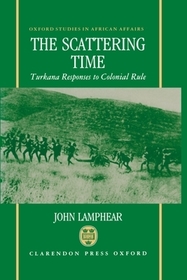
A study of the armed resistance of the Turkana people of north-western Kenya to British colonial administration in the early 20th century. The author takes full account of the military history of the period, and addresses the fundamental question of why some African societies met the European advance with armed resistance while others did not.
MoreLong description:
This is the first full study of the Turkana people of north-western Kenya and their armed resistance of the Turkana people of north-western Kenya to British colonial administration in the early twentieth century. From their first encounters with the colonial vanguard in the 1890s to the final surrender of the Great Diviner, Loolel Kokoi, in 1926, the Turkana resisted imperial conquest. Even after the imposition of colonial rule, they continued to oppose the administration through a variety of strategies.
John Lamphear explores their responses to European colonialism and examines the nature of their resistance, making extensive use of oral sources, as well as archival and published material. His analysis takes full account of the military history of the period, and addresses the fundamental question of why some African societies met the European advance with armed resistance while others did not. In doing so, he makes an important contribution to the historiography of the imperial conquest of Kenya.
I'a useful addition to the scholarship on African resistance to colonial rule.'
P.F. Barty, University of North Alabama, Choice, Apr '93

