

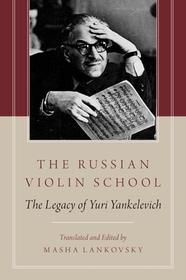
The Russian Violin School
The Legacy of Yuri Yankelevich
- Publisher's listprice GBP 42.99
-
19 409 Ft (18 485 Ft + 5% VAT)
The price is estimated because at the time of ordering we do not know what conversion rates will apply to HUF / product currency when the book arrives. In case HUF is weaker, the price increases slightly, in case HUF is stronger, the price goes lower slightly.
- Discount 10% (cc. 1 941 Ft off)
- Discounted price 17 468 Ft (16 637 Ft + 5% VAT)
Subcribe now and take benefit of a favourable price.
Subscribe
19 409 Ft

Availability
printed on demand
Why don't you give exact delivery time?
Delivery time is estimated on our previous experiences. We give estimations only, because we order from outside Hungary, and the delivery time mainly depends on how quickly the publisher supplies the book. Faster or slower deliveries both happen, but we do our best to supply as quickly as possible.
Product details:
- Publisher OUP USA
- Date of Publication 25 August 2016
- ISBN 9780199917624
- Binding Paperback
- No. of pages288 pages
- Size 231x155x17 mm
- Weight 408 g
- Language English 0
Categories
Short description:
The Russian Violin School: The Legacy of Yuri Yankelevich is the first English translation of the methodological works by Yuri Yankelevich, one of the most important violin teachers of 20th Century Russia. Casting an entirely new light on the Russian Violin School, this book includes two original texts by Yankelevich addressing positioning and shifting along with material by prominent violinists examining his pedagogy.
MoreLong description:
The Russian school of violin playing produced many of the twentieth century's leading violinists - from the famed disciples of Leopold Auer such as Jascha Heifetz, Nathan Milstein, and Mischa Elman to masters of the Soviet years such as David Oistrakh and Leonid Kogan. Though descendants of this school of playing are found today in every major orchestra and university, little is known about the pedagogical traditions of the Russian, and later Soviet, violin school.
Following the revolution of 1917, the center of Russian violin playing and teaching shifted from St. Petersburg to Moscow, where violinists such as Lev Tseitlin, Konstantin Mostras, and Abraham Yampolsky established an influential pedagogical tradition. Founded on principles of scientific inquiry and physiology, this tradition became known as the Soviet Violin School, a component of the larger Russian Violin School.
Yuri Yankelevich (1909 - 1973), a student and assistant of Abraham Yampolsky, was greatly influenced by the teachers of the Soviet School and in turn he became one of the most important pedagogues of his generation. Yankelevich taught at the Moscow Conservatory from 1936 to 1973 and produced a remarkable array of superb violinists, including forty prizewinners in international competitions.
Extremely interested in the methodology of violin playing and teaching, Yankelevich contributed significant texts to the pedagogical literature. Despite its importance, Yankelevich's scholarly work has been little known outside of Russia. This book includes two original texts by Yankelevich: his essay on positioning the hands and arms and his extensive research into every detail of shifting positions. Additional essays and commentaries by those close to him examine further details of his pedagogy, including tone production, intonation, vibrato, fingerings and bowings, and his general approach to methodology and selecting repertoire.
An invaluable resource for any professional violinist, Yankelevich's work reveals an extremely sophisticated approach to understanding the interconnectivity of all components in playing the violin and is complete with detailed practical suggestions and broad historical context.
Table of Contents:
Table of Contents
Introduction Yuri Yankelevich and the Russian School of Violin Playing
Part I
Chapter 1 Yuri Yankelevich: Setting up the Violin and Bow Hold
Chapter2 Yuri Yankelevich: Shifting in Conjunction with the Musical Goals of the Violinist
1. General perception of the positions. Different systems of dividing the fingerboard; their conventions and modifications in the evolution of violin playing
2. Shifting and the problem of intonation. The aural perception of intervals and the role this plays in developing a sense of distance on the fingerboard
3. Particularities of moving the left hand along the fingerboard and changing positions in various parts of the fingerboard - in search of the most efficient techniques
4. Relaxed movement as an essential condition for realizing artistic intentions. An analysis of the reasons restricting the movement of the left hand while changing positions
5. An optimal setup and developing correct playing movements
6. Particularities of descending shifts. Coordination between the principal movements of the left hand while shifting
7. General principles of shifting in cantilena and technical passages. The role of objective methodology in analyzing shifting. A classification of shifts
8. Details of executing different types of shifts. How different shifting techniques depend on musical context
9. Shifts made with the help of an open string or natural harmonic. Shifts using chromatic glissando
10. Shifting in double stops: octaves and tenths, thirds and fingered octaves, sixths and fourths
11. The interdependence of the left and right hands while shifting. Methods of shifting while changing bows. Shifts and various bow strokes
Part II
Chapter 3 Maya Glezarova: Aspects of Yankelevich's Teaching Methods
Chapter 4 Vladimir Grigorev: Yankelevich's Methodological System
Appendix A: Selected students and assistants of Yuri Yankelevich
Appendix B: Methodological writings by Yuri Yankelevich
Appendix C: Compositions edited by Yuri Yankelevich
Bibliography

