

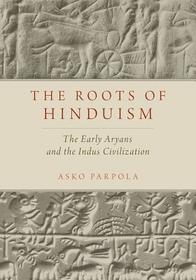
The Roots of Hinduism
The Early Aryans and The Indus Civilization
- Publisher's listprice GBP 49.99
-
22 570 Ft (21 495 Ft + 5% VAT)
The price is estimated because at the time of ordering we do not know what conversion rates will apply to HUF / product currency when the book arrives. In case HUF is weaker, the price increases slightly, in case HUF is stronger, the price goes lower slightly.
- Discount 10% (cc. 2 257 Ft off)
- Discounted price 20 313 Ft (19 346 Ft + 5% VAT)
Subcribe now and take benefit of a favourable price.
Subscribe
22 570 Ft

Availability
printed on demand
Why don't you give exact delivery time?
Delivery time is estimated on our previous experiences. We give estimations only, because we order from outside Hungary, and the delivery time mainly depends on how quickly the publisher supplies the book. Faster or slower deliveries both happen, but we do our best to supply as quickly as possible.
Product details:
- Publisher OUP USA
- Date of Publication 27 August 2015
- ISBN 9780190226923
- Binding Paperback
- No. of pages384 pages
- Size 251x175x20 mm
- Weight 612 g
- Language English
- Illustrations 190 illus. 0
Categories
Short description:
In this pioneering book, Asko Parpola traces the Indo-Iranian speakers from the Aryan homeland north of the Black Sea through the Eurasian steppes to Central, West and South Asia, presenting new ideas on the origin and formation of the Vedic literature and rites, and the great Hindu epics.
MoreLong description:
Hinduism has two major roots. The more familiar is the religion brought to South Asia in the second millennium BCE by speakers of Aryan or Indo-Iranian languages, a branch of the Indo-European language family. Another, more enigmatic, root is the Indus civilization of the third millennium BCE, which left behind thousands of short inscriptions in a forgotten pictographic script. Discovered in the valley of the Indus River in the early 1920s, the Indus civilization had a population estimated at one million people, in more than 1000 settlements, several of which were cities of some 50,000 inhabitants. With an area of nearly a million square kilometers, the Indus civilization was more extensive than the other key urban cultures of the time, in Mesopotamia and Egypt. Yet, after almost a century of excavation and research the Indus civilization remains little understood. What language did the Indus people speak? How might we decipher the exquisitely carved Indus inscriptions? What deities did they worship? Are the roots of contemporary Hinduism to be found in the religion of the Indus civilization as well as in the Vedic religion?
Since the rise of Hindu nationalist politics in the 1980s, these questions have been debated with increasing animosity, colored by the history of modern colonialism in India. This is especially true of the enigmatic Indus script, which is at the hub of the debates, and a particular focus of this book. Asko Parpola has spent fifty years researching the roots of Hinduism to answer these fundamental questions. In this pioneering book, he traces the Indo-Iranian speakers from the Aryan homeland north of the Black Sea through the Eurasian steppes to Central, West, and South Asia. Among many other things, he discusses the profound impact of the invention of the horse-drawn chariot on Indo-Aryan religion, and presents new ideas on the origin and formation of the Vedic literature and rites, and the great Hindu epics.
Table of Contents:
Preface
Introduction
1. Defining 'Hindu' and 'Hinduism'
2. The early Aryans
3. Indo-European linguistics
4. The Indus civilization
5. The Indus religion and the Indus script
Part I: The Early Aryans
6. Proto-Indo-European homelands
7. Early Indo-Iranians on the Eurasian steppes
8. The BMAC of Central Asia and the Mitanni of Syria
9. The Rigvedic Indo-Aryans and the D?sas
10. The Asvins and Mitra-Varuna
11. The Asvins as funerary gods
12. The Atharvaveda and the Vratyas
13. The Kuru kingdom and the great epics
Part II: The Indus Civilization
14. The language of the Indus civilization
15. Fertility cults in folk religion
16. Astronomy, time-reckoning and cosmology
17. Dilmun, Magan and Meluhha
18. Royal symbols from West Asia
19. The Goddess and the buffalo
20. Early Iranians and 'left-hand' Tantrism
21. Religion in the Indus script
Conclusion
22. The prehistory of Indo-Aryan speech and Aryan contributions to Hinduism
23. Harappan religion in relation to West Asia and later South Asia
24. Retrospect and prospect
Bibliographical notes
References
Index

