

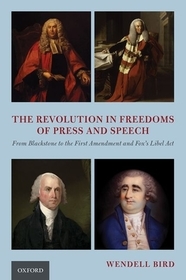
The Revolution in Freedoms of Press and Speech
From Blackstone to the First Amendment and Fox's Libel Act
- Publisher's listprice GBP 120.00
-
54 180 Ft (51 600 Ft + 5% VAT)
The price is estimated because at the time of ordering we do not know what conversion rates will apply to HUF / product currency when the book arrives. In case HUF is weaker, the price increases slightly, in case HUF is stronger, the price goes lower slightly.
- Discount 10% (cc. 5 418 Ft off)
- Discounted price 48 762 Ft (46 440 Ft + 5% VAT)
Subcribe now and take benefit of a favourable price.
Subscribe
54 180 Ft

Availability
Estimated delivery time: In stock at the publisher, but not at Prospero's office. Delivery time approx. 3-5 weeks.
Not in stock at Prospero.
Why don't you give exact delivery time?
Delivery time is estimated on our previous experiences. We give estimations only, because we order from outside Hungary, and the delivery time mainly depends on how quickly the publisher supplies the book. Faster or slower deliveries both happen, but we do our best to supply as quickly as possible.
Product details:
- Publisher OUP USA
- Date of Publication 22 April 2020
- ISBN 9780197509197
- Binding Hardback
- No. of pages408 pages
- Size 160x239x35 mm
- Weight 703 g
- Language English 0
Categories
Short description:
This book discusses the revolutionary broadening of concepts of freedom of press and freedom of speech in Great Britain and in America in the late eighteenth century, in the period that produced state declarations of rights and then the First Amendment and Fox's Libel Act.
MoreLong description:
This book discusses the revolutionary broadening of concepts of freedom of press and freedom of speech in Great Britain and in America in the late eighteenth century, in the period that produced state declarations of rights and then the First Amendment and Fox's Libel Act.
The conventional view of the history of freedoms of press and speech is that the common law since antiquity defined those freedoms narrowly, and that Sir William Blackstone in 1769, and Lord Chief Justice Mansfield in 1770, faithfully summarized the common law in giving a very narrow definition of those freedoms as mere liberty from prior restraint and not liberty from punishment after something was printed or spoken.
This book proposes, to the contrary, that Blackstone carefully selected the narrowest definition that had been suggested in popular essays in the prior seventy years, in order to oppose the growing claims for much broader protections of press and speech. Blackstone misdescribed his summary as an accepted common law definition, which in fact did not exist. A year later, Mansfield inserted a similar definition into the common law for the first time, also misdescribing it as a long-accepted definition, and soon misdescribed the unique rules for prosecuting sedition as having an equally ancient pedigree. Blackstone and Mansfield were not declaring the law as it had long been, but were leading a counter-revolution about the breadth of freedoms of press and speech, and cloaking it as a summary of a narrow common law doctrine that in fact was nonexistent.
That conflict of revolutionary view and counter-revolutionary view continues today. For over a century, a neo-Blackstonian view has been dominant, or at least very influential, among historians. Contrary to those narrow claims, this book concludes that the broad understanding of freedoms of press and speech was the dominant context of the First Amendment and of Fox's Libel Act, and that it enjoyed greater historical support.
Wendell Bird's extraordinary books on the history of the Sedition Act make clear how ... [a]rguments against the Blackstonian understanding of freedom of speech and freedom of the press were part of creating a republican government rooted in individual rights and popular sovereignty--a government that provided for robust political dissent and a loyal opposition ....
Table of Contents:
List of Illustrations
List of Abbreviations
Introduction
Part I The Devising of Narrow Liberties of Press and Speech
Chapter 1: Blackstone's and Mansfield's Narrow Liberties of Press and Speech, and Broad Crimes of Seditious Libel and Seditious Words: Summaries or Misdescriptions of an Ancient Common Law?
Chapter 2: The Crimes of Seditious Libel and Seditious Speech: Weapons for Suppressing Dissent in Britain and America?
Part II The British Broadening of Liberties of Press and Speech
Chapter 3: The Emerging Broad British View of Freedoms of Press and Speech, Before the Colonial Crisis
Chapter 4: The Prevailing British View of Freedoms of Press and Speech, in the Decade Before the American Revolution and Declarations of Rights
Chapter 5: The Dominant British View of Freedoms of Press and Speech, in the Decade Before Fox's Libel Act and America's Bill of Rights
Part III The American Development of Broad Rights of Press and Speech
Chapter 6: The Emergence of Expansive American Views of Freedoms of Press and Speech, Before the Colonial Crisis
Chapter 7: Reasons for the Spread of Broad Views of Liberties of Press and Speech in America, During and After the Colonial Crisis
Chapter 8: The Prevailing Broad View by the Popular Party of Freedoms of Press and Speech, in the Prerevolutionary Decade Before the American States' Declarations of Rights
Chapter 9: The Dominant American View of Freedoms of Press and Speech, in the Decade Leading up to Ratification of the Federal Bill of Rights
Chapter 10: The Constitutional Understanding of Freedoms of Press and Speech, and of Seditious Libel, in Discussions of State and Federal Bills of Rights
Epilogue

