

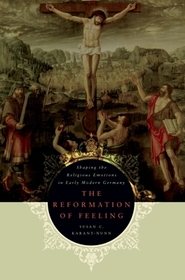
The Reformation of Feeling
Shaping the Religious Emotions in Early Modern Germany
- Publisher's listprice GBP 58.00
-
26 187 Ft (24 940 Ft + 5% VAT)
The price is estimated because at the time of ordering we do not know what conversion rates will apply to HUF / product currency when the book arrives. In case HUF is weaker, the price increases slightly, in case HUF is stronger, the price goes lower slightly.
- Discount 10% (cc. 2 619 Ft off)
- Discounted price 23 568 Ft (22 446 Ft + 5% VAT)
Subcribe now and take benefit of a favourable price.
Subscribe
26 187 Ft

Availability
printed on demand
Why don't you give exact delivery time?
Delivery time is estimated on our previous experiences. We give estimations only, because we order from outside Hungary, and the delivery time mainly depends on how quickly the publisher supplies the book. Faster or slower deliveries both happen, but we do our best to supply as quickly as possible.
Product details:
- Publisher OUP USA
- Date of Publication 18 October 2012
- ISBN 9780199964017
- Binding Paperback
- No. of pages354 pages
- Size 231x155x20 mm
- Weight 476 g
- Language English 0
Categories
Short description:
In The Reformation of Feeling, Susan Karant-Nunn looks beyond and beneath the formal doctrinal and moral demands of the Reformation in Germany to examine the emotional tenor of the programs that the emerging creeds-revised Catholicism, Lutheranism, and Calvinism/Reformed theology-developed for their members.
MoreLong description:
In The Reformation of Feeling, Susan Karant-Nunn looks beyond and beneath the formal doctrinal and moral demands of the Reformation in Germany to examine the emotional tenor of the programs that the emerging creeds-revised Catholicism, Lutheranism, and Calvinism/Reformed theology-developed for their members. As revealed by the surviving sermons from this period, preaching clergy of each faith both explicitly and implicitly provided their listeners with distinct models of a mood to be cultivated. To encourage their parishioners to make an emotional investment in their faith, all three drew upon rhetorical elements that were already present in late medieval Catholicism and elevated them into confessional touchstones.
Looking at archival materials containing direct references to feeling, Karant-Nunn focuses on treatments of death and sermons on the Passion. She amplifies these sources with considerations of the decorative, liturgical, musical, and disciplinary changes that ecclesiastical leaders introduced during the period from the late fifteenth to the end of the seventeenth century. Within individual sermons, Karant-Nunn also examines topical elements-including Jews at the crucifixion, the Virgin Mary's voluminous weeping below the Cross, and struggles against competing denominations-that were intended to arouse particular kinds of sentiment. Finally, she discusses surviving testimony from the laity in order to assess at least some Christians' reception of these lessons on proper devotional feeling.
This book is exceptional in its presentation of a cultural rather than theological or behavioral study of the broader movement to remake Christianity. As Karant-Nunn conclusively demonstrates, in the eyes of the Reformation's formative personalities strict adherence to doctrine and upright demeanor did not constitute an adequate piety. The truly devout had to engage their hearts in their faith.
After having devoured this engrossing and magisterial study, one truly must wonder why Susan Karant-Nunn is the first to take up the topic of the emotional cultures that emerged from the various Reform movements. Meticulously researched and superbly synthesized, The Reformation of Feeling is a landmark study in Reformation Studies - stepping stone to a cultural history of the Reformation.
Table of Contents:
Introduction
Chapter 1. The Emotions in Early-Modern Catholicism
Chapter 2. The Lutheran Churches
Chapter 3. The Reformed Churches
Chapter 4. Condemnation of the Jews
Chapter 5. The Mother Stood at the Foot of the Cross: Mary's Suffering as Incentive to Feel
Chapter 6. Proper Feelings in and around the Death-Bed
Chapter 7. The Formation of Religious Sensibilities: The Reception of Recommendations for Proper Feeling
Chapter 8. The Religious Emotions: Conclusions
Notes
Index

