

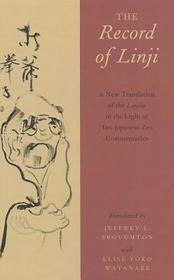
The Record of Linji
A New Translation of the Linjilu in the Light of Ten Japanese Zen Commentaries
- Publisher's listprice GBP 110.00
-
49 665 Ft (47 300 Ft + 5% VAT)
The price is estimated because at the time of ordering we do not know what conversion rates will apply to HUF / product currency when the book arrives. In case HUF is weaker, the price increases slightly, in case HUF is stronger, the price goes lower slightly.
- Discount 10% (cc. 4 967 Ft off)
- Discounted price 44 699 Ft (42 570 Ft + 5% VAT)
Subcribe now and take benefit of a favourable price.
Subscribe
49 665 Ft

Availability
printed on demand
Why don't you give exact delivery time?
Delivery time is estimated on our previous experiences. We give estimations only, because we order from outside Hungary, and the delivery time mainly depends on how quickly the publisher supplies the book. Faster or slower deliveries both happen, but we do our best to supply as quickly as possible.
Product details:
- Publisher OUP USA
- Date of Publication 14 February 2013
- ISBN 9780199936410
- Binding Hardback
- No. of pages336 pages
- Size 163x236x22 mm
- Weight 607 g
- Language English 0
Categories
Short description:
The Linjilu (Record of Linji or LJL) is one of the foundational texts of Chan/Zen Buddhist literature, and an accomplished work of baihua (vernacular) literature. This bracing new translation transmits the LJL's living expression of Zen's "personal realization of the meaning beyond words," as interpreted by ten commentaries produced by Japanese Zen monks, over a span of over four centuries, ranging from the late 1300s, when Five-Mountains Zen flourished in Kyoto and Kamakura, through the early 1700s, an age of thriving interest in the LJL.
MoreLong description:
The Linjilu (Record of Linji or LJL) is one of the foundational texts of Chan/Zen Buddhist literature, and an accomplished work of baihua (vernacular) literature. Its indelibly memorable title character, the Master Linji--infamous for the shout, the whack of the rattan stick, and the declaration that sutras are toilet paper--is himself an embodiment of the very teachings he propounds to his students: he is a "true person," free of dithering; he exhibits the non-verbal, unconstrained spontaneity of the buddha-nature; he is always active, never passive; and he is aware that nothing is lacking at all, at any time, in his round of daily activities. This bracing new translation transmits the LJL's living expression of Zen's "personal realization of the meaning beyond words," as interpreted by ten commentaries produced by Japanese Zen monks, over a span of over four centuries, ranging from the late 1300s, when Five-Mountains Zen flourished in Kyoto and Kamakura, through the early 1700s, an age of thriving interest in the LJL. These Zen commentaries form a body of vital, in-house interpretive literature never before given full credit or center stage in previous translations of the LJL. Here, their insights are fully incorporated into the translation itself, allowing the reader unimpeded access throughout, with more extensive excerpts available in the notes. Also provided is a translation of the earliest extant material on Linji, including a neglected transmission-record entry relating to his associate Puhua, which indicate that the LJL is a fully-fledged work of literature that has undergone editorial changes over time to become the compelling work we know today.
Jeffrey Broughton's Record of Linji is a magnificent work of scholarship. It translates what the author rightly calls 'the most prominent work in all of Chan literature,' and goes far beyond all previous translations in making this seminal text understandable by embedding the ten most important Zen commentaries into the original text. This rich textual tradition is made readily available to readers of Broughton's translation and the result is an opportunity to enter into Chan and Zen discourse that has been previously unavailable to western readers.
Table of Contents:
Acknowledgments
Abbreviations
Introduction
Translation of the Linjilu
Part I: Dharma-Hall Convocations
Part II: Sangha Instruction
Part III: Calibrating and Adjudicating
Part IV: Record of the Karman of the Master's Career
Part V: Stupa Record of Chan Master Linji Huizhao
Yuanjue Zongyan's Xuanhe 2 (1120) Linjilu Edition (LJL)
Appendix 1: Pre-Song Linji and Puhua Sayings and Episodes Preserved in the Collection of the Patriarchal Hall (Zutangji)
Appendix 2: Pre-Song Linji Sayings Preserved in the Mind-Mirror Record (Zongjinglu)
Notes
Bibliography
Index

