

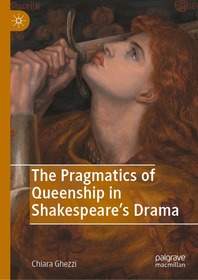
The Pragmatics of Queenship in Shakespeare's Drama
- Publisher's listprice EUR 96.29
-
37 610 Ft (35 819 Ft + 5% VAT)
The price is estimated because at the time of ordering we do not know what conversion rates will apply to HUF / product currency when the book arrives. In case HUF is weaker, the price increases slightly, in case HUF is stronger, the price goes lower slightly.
- Discount 20% (cc. 7 522 Ft off)
- Discounted price 30 088 Ft (28 655 Ft + 5% VAT)
- Discount is valid until: 30 June 2026
Subcribe now and take benefit of a favourable price.
Subscribe
33 097 Ft

Availability
Not yet published.
Why don't you give exact delivery time?
Delivery time is estimated on our previous experiences. We give estimations only, because we order from outside Hungary, and the delivery time mainly depends on how quickly the publisher supplies the book. Faster or slower deliveries both happen, but we do our best to supply as quickly as possible.
Product details:
- Publisher Springer Nature Switzerland
- Date of Publication 26 May 2026
- ISBN 9783032170989
- Binding Hardback
- No. of pages209 pages
- Size 210x148 mm
- Language English
- Illustrations XIX, 209 p. 65 illus. 700
Categories
Long description:
"
This book addresses the characterisation and representation of female authority in Shakespeare’s political plays by collecting the linguistic behavioural patterns of the queens of the first tetralogy (King Henry VI Part 1, 2, 3 and King Richard III) – Margaret of Anjou, Elizabeth Woodville and Anne Neville – and so by detecting the nature and evolution of their agency. The study is collocated in the field of literary and historical linguistics and draws on an interdisciplinary analytical model informed by pragmatics, (Austin 1962, Leech 1983, Brown and Levinson 1987, Culpeper 1996), stylistics (Simpson 1993, 2004, Burke 2014) and rhetoric (Perelman and Olbrechts-Tyteca 1973, Kienpointner 1987). The resulting analysis gathers and lists the sequence of linguistic recurrences of definite characters through a rigorous methodology, aiming to prove whether and how these queens retain the power to influence the course of the story as well as the other characters through the illocutionary and perlocutionary force of their chosen speech acts, the number and length of their turns, the (im)polite verbal behaviour they perform in face-to-face situations. The conclusion of the study points out its replicability for other sources with the purpose of finding new insights in historical/literary texts and of understanding characterisation through linguistics.
" MoreTable of Contents:
"
Chapter 1. Introduction.- Chapter 2. The Representation Of Women In The Renaissance.- Chapter 3. Early Modern Rhetoric.- Chapter 4. Theoretical Background.- Chapter 5. Data And Analysis.
" More
