

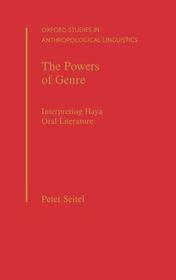
The Powers of Genre
Interpreting Haya Oral Literature
Series: Oxford Studies in Anthropological Linguistics; 22;
- Publisher's listprice GBP 165.00
-
74 497 Ft (70 950 Ft + 5% VAT)
The price is estimated because at the time of ordering we do not know what conversion rates will apply to HUF / product currency when the book arrives. In case HUF is weaker, the price increases slightly, in case HUF is stronger, the price goes lower slightly.
- Discount 10% (cc. 7 450 Ft off)
- Discounted price 67 048 Ft (63 855 Ft + 5% VAT)
Subcribe now and take benefit of a favourable price.
Subscribe
74 497 Ft

Availability
printed on demand
Why don't you give exact delivery time?
Delivery time is estimated on our previous experiences. We give estimations only, because we order from outside Hungary, and the delivery time mainly depends on how quickly the publisher supplies the book. Faster or slower deliveries both happen, but we do our best to supply as quickly as possible.
Product details:
- Publisher OUP USA
- Date of Publication 8 April 1999
- ISBN 9780195117004
- Binding Hardback
- No. of pages264 pages
- Size 173x225x21 mm
- Weight 567 g
- Language English 0
Categories
Short description:
The Powers of Genre describes a method for interpreting oral literature that enables dialogue between insiders and outsiders to a tradition. Seitel illustrates this method with lively examples from Haya (from Northwestern Tanzania) proverbs, folktales, and heroic verse. He then focuses on a single epic ballad to demonstrate, among other things, why stanzas need not rhyme, and how significance needs time in oral poetry and narrative. He makes a controversial claim that an heroic age, similar to that of Ancient Greece, existed in Sub-Saharan Africa. The work should interest anyone who works in oral literature and narrative -- folklorists, literary critics, anthropologists, linguists, and Africanists.
MoreLong description:
The Powers of Genre describes a method for interpreting oral literature that enables dialogue between insiders and outsiders to a tradition. Seitel illustrates this method with lively examples from Haya (from Northwestern Tanzania) proverbs, folktales, and heroic verse. He then focuses on a single epic ballad to demonstrate, among other things, why stanzas need not rhyme, and how significance needs time in oral poetry and narrative. He makes a controversial claim that an heroic age, similar to that of Ancient Greece, existed in Sub-Saharan Africa. The work should interest anyone who works in oral literature and narrative -- folklorists, literary critics, anthropologists, linguists, and Africanists.
Seitel's argument proceeds elegantly from the simplicity to complexity. After setting out his aims and defining his terms, and introducing the Haya and their oral literature, he offers successive analyses of proverbs, folktales, and heroic ballads, amplifying and extending his techniques on the way.

