

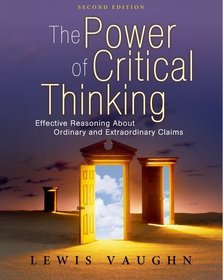
The Power of Critical Thinking
Effective Reasoning about Ordinary and Extraordinary Claims
- Publisher's listprice GBP 47.99
-
21 667 Ft (20 635 Ft + 5% VAT)
The price is estimated because at the time of ordering we do not know what conversion rates will apply to HUF / product currency when the book arrives. In case HUF is weaker, the price increases slightly, in case HUF is stronger, the price goes lower slightly.
- Discount 10% (cc. 2 167 Ft off)
- Discounted price 19 500 Ft (18 572 Ft + 5% VAT)
Subcribe now and take benefit of a favourable price.
Subscribe
21 667 Ft

Availability
Out of print
Why don't you give exact delivery time?
Delivery time is estimated on our previous experiences. We give estimations only, because we order from outside Hungary, and the delivery time mainly depends on how quickly the publisher supplies the book. Faster or slower deliveries both happen, but we do our best to supply as quickly as possible.
Product details:
- Edition number 2
- Publisher Oxford University Press
- Date of Publication 6 December 2007
- ISBN 9780195320411
- Binding Paperback
- No. of pages560 pages
- Size 255x203x19 mm
- Weight 981 g
- Language English
- Illustrations 99 illustrations 0
Categories
Short description:
This is the second edition of this successful critical thinking text. It includes all of the core topics covered in the course, such as critical reasoning, argumentation, logic, and argumentative essay writing, but also introduces topics such as inference to best explanation and scientific reasoning. The new edition also includes material on evaluating evidence and credibility, evaluating the media/advertising, and intelligent design. The art program has been expanded from 25 to 60
photographs, and the book will now be in full colour.
Long description:
Enhanced by many innovative exercises, examples, and pedagogical features, The Power of Critical Thinking: Effective Reasoning About Ordinary and Extraordinary Claims, Second Edition, explores the essentials of critical reasoning, argumentation, logic, and argumentative essay writing while also incorporating material on important topics that most other texts leave out. Author Lewis Vaughn offers comprehensive treatments of core topics, including an introduction to claims
and arguments, discussions of propositional and categorical logic, and full coverage of the basics of inductive reasoning. Building on this solid foundation, he also delves into areas neglected by other texts, adding extensive material on "inference to the best explanation" and on scientific reasoning; a
thorough look at the evaluation of evidence and credibility; and a chapter on the psychological and social factors that can impede critical thinking. Additional notable elements are a chapter on moral reasoning, advice on how to evaluate Internet sources, and guidelines for evaluating occult, paranormal, or supernatural claims.
The Power of Critical Thinking, Second Edition, integrates many pedagogical features including hundreds of diverse exercises, examples, and illustrations; progressive, stand-alone writing modules; numerous text boxes; step-by-step guidelines for evaluating claims, arguments, and explanations; a glossary of important terms; and many reminders, summaries, and review notes throughout. The text is supplemented by a
companion website at www.oup.com/us/criticalthinking (offering a student study guide and more), and an Instructor's Manual with Test Questions (available both in print and on a CD).
This unique text features a modular structure that allows instructors to teach the chapters in almost any order. Written in a student-friendly style and enhanced by humor where appropriate, it is ideal for courses in critical thinking, introduction to logic, informal logic, argumentative writing, and introduction to argumentation.
New to the Second Edition
* Full-color throughout and an expanded art program (37 more photos and illustrations)
* A new writing module--an annotated sample student paper--and five additional essays for analysis
* A new section on evaluating news reports and advertising
* Timely discussions of intelligent design and population (nonintervention) studies
* Expanded coverage of experts and authors and reasons to doubt their reliability
* More "Field Problems" and exercise questions
* Chapter objectives and key terms with definitions for each chapter
Table of Contents:
Preface
1. BASICS
1. The Power of Critical Thinking
Why It Matters
How It Works
Summary
Exercises
Field Problems
Self-Assessment Quiz
Critical Thinking and Writing: Module 1
Writing Assignments
2. The "Environment" of Critical Thinking
Perils of a Haunted Mind
Perils of a Haunted Worldview
Summary
Exercises
Field Problems
Self-Assessment Quiz
Integrative Exercises
Critical Thinking and Writing: Module 2
Writing Assignments
3. Making Sense of Arguments
Argument Basics
Judging Arguments
Finding Missing Parts
Argument Patterns
Diagramming Arguments
Assessing Long Arguments
Summary
Field Problems
Self-Assessment Quiz
Integrative Exercises
Critical Thinking and Writing: Module 3
Writing Assignments
2. REASONS
4. Reasons for Belief and Doubt
When Claims Conflict
Experts and Evidence
Personal Experience
Fooling Ourselves
Claims in the News
Advertising and Persuasion
Summary
Exercises
Field Problems
Self-Assessment Quiz
Integrative Exercises
Critical Thinking and Writing: Module 4
Writing Assignments
5. Faulty Reasoning
Irrelevant Premises
Unacceptable Premises
Summary
Exercises
Field Problems
Self-Assessment Quiz
Integrative Exercises
Critical Thinking and Writing: Module 5
Writing Assignments
3. ARGUMENTS
6. Deductive Reasoning: Propositional Logic
Connectives and Truth Values
Checking for Validity
Summary
Field Problems
Self-Assessment Quiz
Integrative Exercises
Writing Assignments
7. Deductive Reasoning: Categorical Logic
Statements and Classes
Translations and Standard Form
Diagramming Categorical Statements
Sizing Up Categorical Syllogisms
Summary
Field Problems
Self-Assessment Quiz
Integrative Exercises
Writing Assignments
8. Inductive Reasoning
Enumerative Induction
Analogical Induction
Causal Arguments
Summary
Field Problems
Self-Assessment Quiz
Integrative Exercises
Writing Assignments
4. EXPLANATIONS
9. Inference to the Best Explanation
Explanations and Inference
Theories and Consistency
Theories and Criteria
Telling Good Theories from Bad
Summary
Field Problems
Self-Assessment Quiz
Integrative Exercises
Writing Assignments
10. Judging Scientific Theories
Science and Not Science
The Scientific Method
Testing Scientific Theories
Judging Scientific Theories
Science and Weird Theories
Making Weird Mistakes
Judging Weird Theories
Summary
Field Problems
Self-Assessment Quiz
Integrative Exercises
Writing Assignments
11. Judging Moral Arguments and Theories
Moral Arguments
Moral Theories
A Coherent Worldview
Summary
Exercises
Field Problems
Self-Assessment Quiz
Integrative Exercises
Writing Assignments
Appendix A: Essays for Evaluation
1. "Death Penalty Discriminates Against Black Crime Victims"
2. "Marine Parks"
3. "The Wrong Ruling on Vouchers"
4. "The Kalam Cosmological Argument"
5. "More Innocents Die When We Don't Have Capital Punishment"
6. "Misleading the Patient for Fun and Profit"
7. "Tight Limits on Stem Cells Betray Research Potential"
8. "The Cohabitation Epidemic"
9. "The Demon-Haunted Sentence: A Skeptical Analysis of Reverse Speech"
10. "Amityville: The Horror of It All"
11. "A Deviance from God's Norm"
12. "Marriage Still Evolving, as Ever"
13. "Slouching Toward Chimeras"
14. "The Right to Ridicule"
15. "Time to Think"
Appendix B: Answers to Exercises
Notes
Glossary
Credits
Index

