

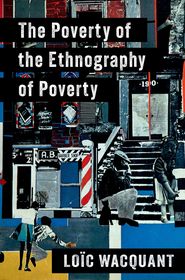
The Poverty of the Ethnography of Poverty
- Publisher's listprice GBP 64.00
-
28 896 Ft (27 520 Ft + 5% VAT)
The price is estimated because at the time of ordering we do not know what conversion rates will apply to HUF / product currency when the book arrives. In case HUF is weaker, the price increases slightly, in case HUF is stronger, the price goes lower slightly.
- Discount 10% (cc. 2 890 Ft off)
- Discounted price 26 006 Ft (24 768 Ft + 5% VAT)
Subcribe now and take benefit of a favourable price.
Subscribe
28 896 Ft

Availability
printed on demand
Why don't you give exact delivery time?
Delivery time is estimated on our previous experiences. We give estimations only, because we order from outside Hungary, and the delivery time mainly depends on how quickly the publisher supplies the book. Faster or slower deliveries both happen, but we do our best to supply as quickly as possible.
Product details:
- Publisher OUP USA
- Date of Publication 2 July 2025
- ISBN 9780197804001
- Binding Hardback
- No. of pages240 pages
- Size 234x156x17 mm
- Weight 513 g
- Language English 608
Categories
Short description:
In The Poverty of the Ethnography of Poverty, Loïc Wacquant dissects how sociologists who carry out field studies of the poor write about race, class, and morality in the city's underbelly; the blinders and biases that affect their research and how to overcome them; and how to become aware of these biases and develop a better meshing of theory and research.
MoreLong description:
Recapitulating the three ages of urban ethnography born in Chicago a century ago, this book puts into historical and analytical perspective a controversy over the ethnography of the nexus of race, class, and morality in and around the black American ghetto in the age of triumphant neoliberalism, in order to draw from it positive lessons for the theory and practice of fieldwork. Thoughtless empiricism, acceptance of problematics prefabricated by ordinary and political common sense, confusion between folk and analytical categories, confinement to the immediate perimeter of interaction, bifurcating moralism: these are all traps that every ethnographer encounters sooner or later on her path and that only collective vigilance can hope to thwart.
This epistemological return is an opportunity to pinpoint the danger of ethnographism, the tendency to want to describe, interpret, and explain a phenomenon based solely on the elements discerned through fieldwork, and to call for the correlative practice of an enactive, structural, and historicized ethnography that sets out to embed the micro-actions observed in the interlocking series of nested social spaces that shape them and give them sense. Such an ethnography allows us to avoid falling into one or another of the five fallacies of participant observation: interactionism, inductivism, populism, presentism, and the hermeneutic drift. And to move beyond Clifford Geertz's "thick description" with the "thick construction" inspired by Pierre Bourdieu, whose mission is to construct scientifically the ordinary social construction of reality.
This is tour-de-force Wacquant at the height of his maturity, erudition, and analytical brilliance, mixing fireworks, reflexivity, humor, and empathy. Dive in headfirst and you will emerge smarter, more alert, and energized to carry out theoretically rich and empirically rigorous fieldwork.
Table of Contents:
Prologue: In Praise of "Thick Construction"
1. Dissecting the Ethnographic Unconscious
2. Poverty, Race, and Moralism in American Urban Ethnography
3. For a Political Epistemology of Fieldwork
Epilogue: Bachelard in the Ghetto
Acknowledgments
References
Index

