

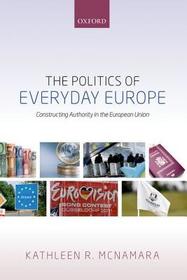
The Politics of Everyday Europe
Constructing Authority in the European Union
- Publisher's listprice GBP 54.00
-
24 381 Ft (23 220 Ft + 5% VAT)
The price is estimated because at the time of ordering we do not know what conversion rates will apply to HUF / product currency when the book arrives. In case HUF is weaker, the price increases slightly, in case HUF is stronger, the price goes lower slightly.
- Discount 10% (cc. 2 438 Ft off)
- Discounted price 21 943 Ft (20 898 Ft + 5% VAT)
Subcribe now and take benefit of a favourable price.
Subscribe
24 381 Ft

Availability
printed on demand
Why don't you give exact delivery time?
Delivery time is estimated on our previous experiences. We give estimations only, because we order from outside Hungary, and the delivery time mainly depends on how quickly the publisher supplies the book. Faster or slower deliveries both happen, but we do our best to supply as quickly as possible.
Product details:
- Publisher OUP Oxford
- Date of Publication 21 May 2015
- ISBN 9780198716235
- Binding Hardback
- No. of pages224 pages
- Size 242x163x19 mm
- Weight 486 g
- Language English 0
Categories
Short description:
As economic and political crises have stretched European social solidarity to the breaking point, this book offers a clear theoretical framework for understanding both the power of everyday culture, and its limits, in legitimating the EU.
MoreLong description:
How do political authorities build support for themselves and their rule? Doing so is key to accruing power, but it can be a complicated affair. The European Union, as a novel political entity, faces a particularly difficult set of challenges. The Politics of Everyday Europe argues that the legitimation of EU authority rests in part on a transformation in the symbols and practices of everyday life in Europe.
The Single Market and the Euro, European citizenship and the dismantling of borders within Europe, EU public architecture, arts and popular entertainment, and EU diplomacy and foreign policy are important not only for their material effects but for how they change peoples' day-to-day experiences and naturalize European governance. The modern nation-state has long used similar strategies to legitimize its political power. But the EU's cultural infrastructure is unique, as it navigates national identities with a particular banality , framing the EU as complementary to, rather than in competition with, the nation-states. These underlying social processes have supported the surprising political development of the EU, but they do so in a way that makes EU authority inherently fragile.
As economic and political crises have stretched European social solidarity to the breaking point, this book offers a clear theoretical framework for understanding both the power of everyday culture, and its limits, in legitimating the EU
The EU response, and the showdowns it has produced in the subsequent years, has been interpreted by observers in two ways. One view holds that the crisis has drawn Europe closer together. This is what the political scientist Kathleen McNamara argues in her thoughtful new book,
Table of Contents:
Introduction
How to Construct a Social Fact
Technologies of Cultural Construction
Buildings, Spectacles, and Songs
Citizenship and Mobility
The Euro and the Single Market
European Foreign Policy
Conclusion

