

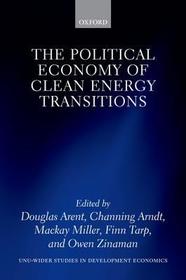
The Political Economy of Clean Energy Transitions
Series: WIDER Studies in Development Economics;
- Publisher's listprice GBP 142.50
-
64 338 Ft (61 275 Ft + 5% VAT)
The price is estimated because at the time of ordering we do not know what conversion rates will apply to HUF / product currency when the book arrives. In case HUF is weaker, the price increases slightly, in case HUF is stronger, the price goes lower slightly.
- Discount 10% (cc. 6 434 Ft off)
- Discounted price 57 905 Ft (55 148 Ft + 5% VAT)
Subcribe now and take benefit of a favourable price.
Subscribe
64 338 Ft

Availability
printed on demand
Why don't you give exact delivery time?
Delivery time is estimated on our previous experiences. We give estimations only, because we order from outside Hungary, and the delivery time mainly depends on how quickly the publisher supplies the book. Faster or slower deliveries both happen, but we do our best to supply as quickly as possible.
Product details:
- Publisher OUP Oxford
- Date of Publication 13 April 2017
- ISBN 9780198802242
- Binding Hardback
- No. of pages632 pages
- Size 241x181x39 mm
- Weight 1042 g
- Language English
- Illustrations Figures and Tables 0
Categories
Short description:
A volume on the political economy of clean energy transition in developed and developing regions, with a focus on the issues that different countries face as they transition from fossil fuels to lower carbon technologies.
MoreLong description:
This is an open access title available under the terms of a CC BY-NC-SA 3.0 IGO licence. It is free to read at Oxford Scholarship Online and offered as a free PDF download from OUP and selected open access locations. The 21st Conference of the Parties (CoP21) to the United Nations Framework Convention on Climate Change (UNFCCC) shifted the nature of the political economy challenge associated with achieving a global emissions trajectory that is consistent with a stable climate. The shifts generated by CoP21 place country decision-making and country policies at centre stage. Under moderately optimistic assumptions concerning the vigour with which CoP21 objectives are pursued, nearly every country will attempt to design and implement the most promising and locally relevant policies for achieving their agreed contribution to global mitigation. These policies will vary dramatically across countries as they embark on an unprecedented era of policy experimentation in driving a clean energy transition.
This book steps into this new world of broad-scale and locally relevant policy experimentation. The chapters focus on the political economy of clean energy transition with an emphasis on specific issues encountered in both developed and developing countries. The authors contribute a broad diversity of experience drawn from all major regions of the world, representing a compendium of what has been learned from recent initiatives, mostly (but not exclusively) at country level, to reduce GHG emissions. As this new era of experimentation dawns, their contributions are both relevant and timely.
Table of Contents:
Part I. The Political Economy of Clean Energy Transitions
Introduction and Synthesis
The history and politics of energy transitions: Comparing contested views and finding common ground
Part II. Climate Policy
Carbon pricing under political Constraints: insights for accelerating clean energy transitions
Border adjustment mechanisms: Elements for economic, legal, and political analysis
Support policies for renewables: Instrument choice and instrument change from a public choice perspective
Part III. Institutions and Governance
Varieties of clean energy transitions in Europe: Political-economic foundations of onshore and offshore wind development
The political economy of energy innovation
Is feed-in-tariff policy effective for increasing deployment of renewable energy in Indonesia?
Do political economy factors matter in explaining the increase in the production of bioenergy?
Understanding indicator choice for the assessment of RD&D financing of low-carbon energy technologies: Lessons from the Nordic countries
An inquiry into the political economy of the global clean energy transition policies and Nigeria's federal and state governments' fiscal policies
Part IV. Actors and Interests
Governing clean energy transitions in China and India
Towards a political economy framework for wind power: Does China break the mould?
The social shaping of nuclear energy technology in South Africa
European energy security: challenges and green opportunities
Part V. Incumbency
Incumbancy and the legal configuration of hydrocarbon infrastructure
Global trends in the political economy of smart grids
Falling oil prices and sustainable energy transition: Towards a multilateral agreement on fossil-fuel subsidies
Part VI. Sector Reform
Post-apartheid electricity policy and the emergence of South Africa's renewable energy sector
Political economy of Nigerian power sector reform
Climate change policy and power sector reform in Mexico under the golden age of gas
Sell the oil deposits! A financial proposal to keep the oil underground in the Yasuni National Park, Ecuador
Part VII. Social Inclusion
Integrating clean energy use in national poverty reduction strategies: Opportunities and challenges in Rwanda's Girinka programme
Renewable energy in the Brazilian Amazon: the drivers of political economy and climate
The political economy of household thermal energy choices in developing countries: comparing the LPG sectors in Indonesia and South Africa
Part VIII. Regional Dynamics
The linkages of energy, water, and land use in Southeast Asia: Challenges and opportunities for the Mekong region
The political economy of clean energy transitions at sub-national level: Understanding the role of international climate regimes in energy policy in two Brazilian states
Implementing EU renewable energy policy at the subnational level: navigating between conflicting interests
Part IX. Moving Forward
Moving forward

