

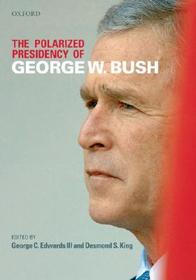
The Polarized Presidency of George W. Bush
- Publisher's listprice GBP 54.00
-
24 381 Ft (23 220 Ft + 5% VAT)
The price is estimated because at the time of ordering we do not know what conversion rates will apply to HUF / product currency when the book arrives. In case HUF is weaker, the price increases slightly, in case HUF is stronger, the price goes lower slightly.
- Discount 10% (cc. 2 438 Ft off)
- Discounted price 21 943 Ft (20 898 Ft + 5% VAT)
Subcribe now and take benefit of a favourable price.
Subscribe
24 381 Ft

Availability
printed on demand
Why don't you give exact delivery time?
Delivery time is estimated on our previous experiences. We give estimations only, because we order from outside Hungary, and the delivery time mainly depends on how quickly the publisher supplies the book. Faster or slower deliveries both happen, but we do our best to supply as quickly as possible.
Product details:
- Publisher OUP Oxford
- Date of Publication 24 May 2007
- ISBN 9780199217977
- Binding Hardback
- No. of pages478 pages
- Size 241x163x30 mm
- Weight 861 g
- Language English
- Illustrations numerous tables and figures 0
Categories
Short description:
This is one of the first major studies of the Bush presidency in which the contributors succeed in looking beyond the simplistic stereotypes of the administration to establish how decisions are taken and how well the administration performs in governing.
MoreLong description:
This collection examines the foreign and domestic policies of President George W Bush's administration. The analysis begins with an account of how highly polarized - in terms of public opinion and electoral patterns - this presidency has proved to be (in a chapter by the editors). This is followed by chapters on the use of unilateral executive powers (by Louis Fisher and William Howell) and pre-rogative powers (by Richard Pious). Because the policy choices of the Bush presidency have had such fundamental effects both in domestic policy and in US foreign policy, three contributors (Thomas Langston, John Burke, James Pfiffner) then address the processes of decision making especially in respect to the war against Iraq. How the administration governs by a recurring process of campaigning is examined in chapters on public opinion and war (by Gary Jacobson), the promotional presidency (by Larry Jacobs), mobilizing congressional support for war (by Scott Blinder) and the White House communications system (by Martha Kumar). Finally the way in which the Bush White House relates to congress and the process of building congressional coalitions to enact laws is the subject of chapters on 'executive style' of this administration (by Charles O Jones) and the failure to reform social security (by Fiona Ross). It will be essential reading for anyone wishing to understand one of the most controversial administrations in recent years.
MoreTable of Contents:
Introduction
Part I: Exercising Power
The Scope of Inherent Powers,
Torture of Detainees and Presidential Prerogative Power
Bending so as Not to Break: What the Bush Presidency Reveals about the Politics of Unilateral Action,
Part II: Decision making
"The Decider's" Path to War in Iraq and the Importance of Personality
From Success to Failure? Iraq and the Organization of George W. Bush's Decision Making
Intelligence and Decision Making Before the War with Iraq
Part III: Governing by Campaigning
The Public, the President, and the War in Iraq
The Promotional Presidency and the New Institutional Toryism: Public Mobilization, Legislative Dominance, and Squandered Opportunities
Going Public, Going to Baghdad: Presidential Agenda-Setting and the Electoral Connection in Congress
Managing the News: The Bush Communications Operation
Part IV: Building Congressional Coalitions
The U. S. Congress and Chief Executive George W. Bush,
Policy Histories and Partisan Leadership in Presidential Studies: The Case of Social Security

