

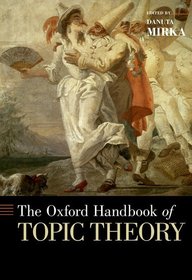
The Oxford Handbook of Topic Theory
Series: Oxford Handbooks;
- Publisher's listprice GBP 162.50
-
73 368 Ft (69 875 Ft + 5% VAT)
The price is estimated because at the time of ordering we do not know what conversion rates will apply to HUF / product currency when the book arrives. In case HUF is weaker, the price increases slightly, in case HUF is stronger, the price goes lower slightly.
- Discount 10% (cc. 7 337 Ft off)
- Discounted price 66 032 Ft (62 888 Ft + 5% VAT)
Subcribe now and take benefit of a favourable price.
Subscribe
73 368 Ft

Availability
printed on demand
Why don't you give exact delivery time?
Delivery time is estimated on our previous experiences. We give estimations only, because we order from outside Hungary, and the delivery time mainly depends on how quickly the publisher supplies the book. Faster or slower deliveries both happen, but we do our best to supply as quickly as possible.
Product details:
- Publisher OUP USA
- Date of Publication 6 November 2014
- ISBN 9780199841578
- Binding Hardback
- No. of pages712 pages
- Size 175x254x45 mm
- Weight 1324 g
- Language English 0
Categories
Short description:
The concept of musical topics describes the aural cross-references between styles and genres. The Oxford Handbook of Topic Theory grounds this concept in eighteenth-century music theory, aesthetics, and criticism, while also documenting historical reality of individual topics, and relating topical analysis to other methods of analyzing eighteenth-century musical repertoire.
MoreLong description:
Topics are musical signs developed and employed primarily during the long eighteenth century. Their significance relies on associations that are clearly recognizable to the listener with different genres, styles and types of music making. Topic theory, which is used to explain conventional subjects of musical composition in this period, is grounded in eighteenth-century music theory, aesthetics, and criticism, while drawing also from music cognition and semiotics. The concept of topics was introduced into by Leonard Ratner in the 1980s to account for cross-references between eighteenth-century styles and genres. As the invention of a twentieth-century academic, topic theory as a field is comparatively new, and The Oxford Handbook of Topic Theory provides a much-needed reconstruction of the field's aesthetic underpinnings.
The volume grounds the concept of topics in eighteenth-century music theory, aesthetics, and criticism. Documenting the historical reality of individual topics on the basis of eighteenth-century sources, it traces the origins of topical mixtures to transformations of eighteenth-century musical life, and relates topical analysis to other methods of music analysis conducted from the perspectives of composers, performers, and listeners. Focusing its scope on eighteenth-century musical repertoire, The Oxford Handbook of Topic Theory lays the foundation for further investigation of topics in music of the nineteenth, twentieth, and twenty-first centuries.
As a collaboration among like-minded scholars, The Oxford Handbook of Topic Theory succeeds admirably. Original insights, detailed historical work, and pertinent musical examples abound ... It is a major achievement and will doubtless inspire fresh engagement with topic theory in the years to come.
Table of Contents:
Introduction
Danuta Mirka
Section I. Origins and Distinctions
Chapter 1. Topics and Opera Buffa
Mary Hunter
Chapter 2. Symphonies and the Public Display of Topics
Elaine Sisman
Chapter 3. Topics in Chamber Music
Dean Sutcliffe
Section II. Contexts, Histories, Sources
Chapter 4. Music and Dance in the Ancien Régime
Lawrence Zbikowski
Chapter 5. Ballroom Dances of the Late Eighteenth Century
Eric McKee
Chapter 6. Hunt, Military, and Pastoral Topics
Andrew Haringer
Chapter 7. Turkish and Hungarian-Gypsy Styles
Catherine Mayes
Chapter 8. The Singing Style
Sarah Day-O'Connell
Chapter 9. Fantasia and Sensibility
Matthew Head
Chapter 10. Ombra and Tempesta
Clive McClelland
Chapter 11. Learned Style and Learned Styles
Keith Chapin
Chapter 12. The Brilliant Style
Roman Ivanovitch
Section III. Analysing Topics
Chapter 13. Topics and Meter
Danuta Mirka
Chapter 14. Topics and Harmonic Schemata: A Case from Beethoven
Vasili Byros
Chapter 15. Topics and Formal Functions: The Case of the Lament
William Caplin
Chapter 16. Topics and Tonal Processes
Joel Galand
Chapter 17. Topics and Form in Mozart's String Quintet in E flat major, K. 614/i
Kofi Agawu
Chapter 18. Topical Figurae: The Double Articulation of Topics
Stephen Rumph
Chapter 19. The Troping of Topics in Mozart's Instrumental Works
Robert Hatten
Section IV. Performing Topics
Chapter 20. Performing Topics in Mozart's Chamber Music with Piano
John Irving
Chapter 21. Recognizing Musical Topics vs. Executing Rhetorical Figures
Tom Beghin
Chapter 22. Eloquent Performance: The Pronuntiatio of Topics
Sheila Guymer
Section V. Listening to Topics
Chapter 23. Amateur Topical Competencies
Melanie Lowe
Chapter 24. Expectation, Musical Topics, and the Problem of Affective Differentiation
Elizabeth Hellmuth Margulis
Chapter 25. Listening to Topics in the Nineteenth Century
Julian Horton

