

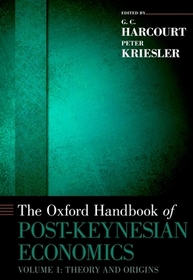
The Oxford Handbook of Post-Keynesian Economics, Volume 1
Theory and Origins
Series: Oxford Handbooks;
- Publisher's listprice GBP 160.00
-
72 240 Ft (68 800 Ft + 5% VAT)
The price is estimated because at the time of ordering we do not know what conversion rates will apply to HUF / product currency when the book arrives. In case HUF is weaker, the price increases slightly, in case HUF is stronger, the price goes lower slightly.
- Discount 10% (cc. 7 224 Ft off)
- Discounted price 65 016 Ft (61 920 Ft + 5% VAT)
Subcribe now and take benefit of a favourable price.
Subscribe
72 240 Ft

Availability
printed on demand
Why don't you give exact delivery time?
Delivery time is estimated on our previous experiences. We give estimations only, because we order from outside Hungary, and the delivery time mainly depends on how quickly the publisher supplies the book. Faster or slower deliveries both happen, but we do our best to supply as quickly as possible.
Product details:
- Publisher OUP USA
- Date of Publication 3 October 2013
- ISBN 9780195390766
- Binding Hardback
- No. of pages636 pages
- Size 180x244x38 mm
- Weight 1179 g
- Language English
- Illustrations 30 illustrations 0
Categories
Short description:
These two volumes cover the principal areas to which Post-Keynesian economists have made distinctive contributions. The contents include the significant criticism by Post-Keynesians of mainstream economics, but the emphasis is on positive Post-Keynesian analysis of the economic problems of the modern world and of policies with which to tackle them.
MoreLong description:
This two volume Handbook contains chapters on the main areas to which Post-Keynesians have made sustained and important contributions. These include theories of accumulation, distribution, pricing, money and finance, international trade and capital flows, the environment, methodological issues, criticism of mainstream economics and Post-Keynesian policies. The Introduction outlines what is in the two volumes, in the process placing Post-Keynesian procedures and contributions in appropriate contexts.
The Oxford Handbook of Post-Keynesian Economics is edited by Geoff Harcourt and Peter Kriesler, therefore you ought immediately to buy it... I congratulate Harcourt and Kriesler, and commend their handbook to every serious economist in the world.
Table of Contents:
Preface and acknowledgements
Introduction - G.C. Harcourt and Peter Kriesler
1. A personal view of the origins of post-Keynesian ideas in the history of economics - Jan Kregel
2. Sraffa, Keynes and post-Keynesianism - Heinz Kurz
3. Sraffa, Keynes and post-Keynesians: Suggestions for a synthesis in the making - Richard Arena and Stephanie Blankenburg
4. On the notion of equilibrium or the centre of gravitation in economic theory - Ajit Sinha
5. Keynesian foundations of post-Keynesian economics - Paul Davidson
6. Money - Randall Wray
7. Post-Keynesian theories of money and credit: conflict and (some) resolutions - Victoria Chick and Sheila Dow
8. The scientific illusion of New Keynesian monetary theory - Colin Rogers
9. Single period analysis and continuation analysis of endogenous money: a revisitation of the debate between horizontalists and structuralists - Giuseppe Fontana
10. Post-Keynesian monetary economics Godley-like - Mark Lavoie
11. Hyman Minsky and the financial instability hypothesis - John King
12. Endogenous growth: A Kaldorian approach - Mark Setterfield
13. Structural economic dynamics and the Cambridge tradition - Prue Kerr and Robert Scazzieri
14. The Cambridge post-Keynesian school of income and wealth distribution - Mauro Baranzini and Amalia Mirante
15. Reinventing macroeconomics - Edward Nell
16. Long-run growth in open economies: export-led cumulative causation or a balance-of-payments constraint? - Robert Blecker
17. Post-Keynesian precepts for nonlinear, endogenous, nonstochastic, business cycle theories - K. Vela Velupillai
18. Post-Keynesian approaches to industrial pricing: a survey and critique - Ken Coutts and Neville Norman
19. Post-Keynesian price theory: from pricing to market governance to the economy as a whole - Frederic S. Lee
20. Kaleckian economics - Robert Dixon and Jan Toporowski
21. Wages policy - John King
22. Discrimination in the labour markets - Peter Riach and Judith Rich
23. Post-Keynesian perspectives on economic development and growth - Peter Kriesler
24. Keynes and economic development - Tony Thirlwall
25. Post-Keynesian economics and the role of aggregate demand in less-developed economies - Amitava Krishna Dutt

