

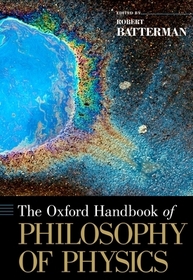
The Oxford Handbook of Philosophy of Physics
Series: Oxford Handbooks;
- Publisher's listprice GBP 177.50
-
80 141 Ft (76 325 Ft + 5% VAT)
The price is estimated because at the time of ordering we do not know what conversion rates will apply to HUF / product currency when the book arrives. In case HUF is weaker, the price increases slightly, in case HUF is stronger, the price goes lower slightly.
- Discount 10% (cc. 8 014 Ft off)
- Discounted price 72 127 Ft (68 693 Ft + 5% VAT)
Subcribe now and take benefit of a favourable price.
Subscribe
80 141 Ft

Availability
printed on demand
Why don't you give exact delivery time?
Delivery time is estimated on our previous experiences. We give estimations only, because we order from outside Hungary, and the delivery time mainly depends on how quickly the publisher supplies the book. Faster or slower deliveries both happen, but we do our best to supply as quickly as possible.
Product details:
- Publisher OUP USA
- Date of Publication 14 March 2013
- ISBN 9780195392043
- Binding Hardback
- No. of pages704 pages
- Size 180x249x43 mm
- Weight 1313 g
- Language English 0
Categories
Short description:
This Handbook provides an overview of many of the topics that currently engage philosophers of physics. It surveys new issues and the problems that have become a focus of attention in recent years. It also provides up-to-date discussions of the still very important problems that dominated the field in the past.
MoreLong description:
This Oxford Handbook provides an overview of many of the topics that currently engage philosophers of physics. It surveys new issues and the problems that have become a focus of attention in recent years. It also provides up-to-date discussions of the still very important problems that dominated the field in the past.
In the late 20th Century, the philosophy of physics was largely focused on orthodox Quantum Mechanics and Relativity Theory. The measurement problem, the question of the possibility of hidden variables, and the nature of quantum locality dominated the literature on the quantum mechanics, whereas questions about relationalism vs. substantivalism, and issues about underdetermination of theories dominated the literature on spacetime. These issues still receive considerable attention from philosophers, but many have shifted their attentions to other questions related to quantum mechanics and to spacetime theories. Quantum field theory has become a major focus, particularly from the point of view of algebraic foundations. Concurrent with these trends, there has been a focus on understanding gauge invariance and symmetries.
The philosophy of physics has evolved even further in recent years with attention being paid to theories that, for the most part, were largely ignored in the past. For example, the relationship between thermodynamics and statistical mechanics---once thought to be a paradigm instance of unproblematic theory reduction---is now a hotly debated topic. The implicit, and sometimes explicit, reductionist methodology of both philosophers and physicists has been severely criticized and attention has now turned to the explanatory and descriptive roles of "non-fundamental,'' phenomenological theories. This shift of attention includes "old'' theories such as classical mechanics, once deemed to be of little philosophical interest. Furthermore, some philosophers have become more interested in "less fundamental'' contemporary physics such as condensed matter theory. Questions abound with implications for the nature of models, idealizations, and explanation in physics. This Handbook showcases all these aspects of this complex and dynamic discipline.
There is much richness here, and an advanced graduate student or an established researcher would learn a great deal from reading the volume from cover to cover ... the volume is excellent. James Owen Weatherall,
Table of Contents:
Introduction
For a Philosophy of Hydrodynamics
What is Classical Mechanics Anyway?
Causation in Classical Mechanics
Theories of Matter: Infinities and Renormalization
Turn and Face the Strange . . . Ch-ch-changes: Philosophical Questions Raised by Phase Transitions
Effective Field Theories
The Tyranny of Scales
Symmetry
Symmetry and Equivalence
Indistinguishability
Unification in Physics
Measurement and Classical Regime in Quantum Mechanics
The Everett Interpretation
Unitary Equivalence and Physical Equivalence
Substantivalist and Relationalist Approaches to Spacetime
Global Spacetime Structure
Philosophy of Cosmology

