

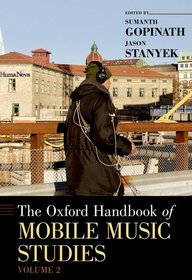
The Oxford Handbook of Mobile Music Studies, Volume 2
Series: Oxford Handbooks;
- Publisher's listprice GBP 160.00
-
72 240 Ft (68 800 Ft + 5% VAT)
The price is estimated because at the time of ordering we do not know what conversion rates will apply to HUF / product currency when the book arrives. In case HUF is weaker, the price increases slightly, in case HUF is stronger, the price goes lower slightly.
- Discount 10% (cc. 7 224 Ft off)
- Discounted price 65 016 Ft (61 920 Ft + 5% VAT)
Subcribe now and take benefit of a favourable price.
Subscribe
72 240 Ft

Availability
printed on demand
Why don't you give exact delivery time?
Delivery time is estimated on our previous experiences. We give estimations only, because we order from outside Hungary, and the delivery time mainly depends on how quickly the publisher supplies the book. Faster or slower deliveries both happen, but we do our best to supply as quickly as possible.
Product details:
- Publisher OUP USA
- Date of Publication 15 May 2014
- ISBN 9780199913657
- Binding Hardback
- No. of pages544 pages
- Size 178x251x35 mm
- Weight 1091 g
- Language English
- Illustrations 24 b&w line drawings; 72 b&w halftones 0
Categories
Short description:
This handbook examines how electrical technologies and their corresponding economies of scale have rendered music and sound increasingly mobile -- portable, fungible, and ubiquitous. Highly interdisciplinary, the two volumes of the Oxford Handbook of Mobile Music Studies consider the devices, markets, and theories of mobile music, and its aesthetics and forms of performance.
MoreLong description:
The Oxford Handbook of Mobile Music Studies consolidates an area of scholarly inquiry that examines how electrical technologies and their corresponding economies of scale have rendered music and sound increasingly mobile -- portable, fungible, and ubiquitous. At once a marketing term, a common mode of everyday-life performance, and an instigator of experimental aesthetics, "mobile music" opens up a space for studying the momentous transformations in the production, distribution, consumption, and experience of music and sound that took place from the late nineteenth to the early twenty-first centuries.
The second volume of the handbook examines the aesthetics of mobile music and its proliferating forms of performance, incorporating epistemologies and methodologies from a number of disciplines, including music studies, sound studies, mobility studies, communication studies, new media studies, performance studies, and more. The contributors draw on political economy and economic sociology, ethnography and autoethnography, musical and sonic transcription, analysis and hermeneutics, and historical and archival research. The chapters treat a significant number of devices, including the the flash drive, the field recorder, the mobile phone, the handheld video game, the laptop computer, the siren, and even a pair of shoes. The Handbook likewise investigates the sonification and musicalization of vehicles -- boom cars, trains, and ice cream trucks -- and the sonics and musics of walking, texting, and commuting. Its chapters cover a large swath of the world -- the US, the UK, Japan, Brazil, Germany, Turkey, Mexico, France, China, Jamaica, Iraq, the Philippines, India -- and a similarly broad array of musical styles and practices, from the recondite and subcultural to the mass-popular and global. The most comprehensive book of its kind, this handbook is a necessary reference for scholars in multiple fields.
A very welcome and totally immersive experience.
Table of Contents:
Contents:
1. The Mobilization of Performance: An Introduction to the Aesthetics of Mobile Music
Sumanth Gopinath and Jason Stanyek
Part I: Frequency-Range Aesthetics
2. Treble Culture
Wayne Marshall
3. Of Sirens Old and New
Alexander Rehding
Part II: Sounding Transport
4. "Cars With the Boom": Music, Automobility, and Hip-hop "Sub" Cultures
Justin Williams
5. Ding, Ding!: The Commodity Aesthetic of Ice Cream Truck Music
Daniel T. Neely
6. There must be some relatIon beTween mushrOoms and trains: Alvin Curran's Boletus Edulis-Musica Pendolare
Benjamin Piekut
Part III: Walking and Bodily Choreography
7. Polyphonies of Footsteps
Frauke Behrendt
8. Soundwalking: Creating Moving Environmental Sound Narratives
Andra McCartney
9. Gestural Choreographies: Embodied Disciplines and Digital Media
Harmony Bench
Part IV: Dance and Dance Musics
10. (In)Visible Mediators: Urban Mobility, Interface Design, and the Disappearing Computer in Berlin-Based Laptop Performances
Mark J. Butler
11. Turning the Tables: Digital Technologies and the Remixing of DJ Culture
Christine Zanfagna and Levitt Brandin, Kate
12. Dancing Silhouettes: The Mobile Freedom of iPod Commercials
Justin D. Burton
Part V: Popular Music Production
13. Music, Mobility, and Distributed Recording Production in Turkish Political Music
Eliot Bates
14. Rhythms of Relation: Black Popular Music and Mobile Technologies
Alexander Weheliye
Part VI: Gaming Aesthetics
15. A History of Handheld and Mobile Video Game Sound
Karen Collins
16. The Chiptuning of the World: Game Boys, Imagined Travel, and Musical Meaning
Chris Tonelli
17. Rhythm Heaven: Video Games, Idols, and Other Experiences of Play
Miki Kaneda
Part VII: Mobile Music Instruments
18. The Mobile Phone Orchestra
Ge Wang, Georg Essl, and Henri Penttinen
19. Creative Applications of Interactive Mobile Music
Atau Tanaka
20. Music-Making and the iPhone: Notes From An Academic Entrepreneur
Ge Wang

