

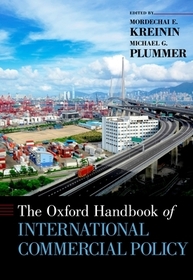
The Oxford Handbook of International Commercial Policy
Series: Oxford Handbooks;
- Publisher's listprice GBP 160.00
-
72 240 Ft (68 800 Ft + 5% VAT)
The price is estimated because at the time of ordering we do not know what conversion rates will apply to HUF / product currency when the book arrives. In case HUF is weaker, the price increases slightly, in case HUF is stronger, the price goes lower slightly.
- Discount 10% (cc. 7 224 Ft off)
- Discounted price 65 016 Ft (61 920 Ft + 5% VAT)
Subcribe now and take benefit of a favourable price.
Subscribe
72 240 Ft

Availability
printed on demand
Why don't you give exact delivery time?
Delivery time is estimated on our previous experiences. We give estimations only, because we order from outside Hungary, and the delivery time mainly depends on how quickly the publisher supplies the book. Faster or slower deliveries both happen, but we do our best to supply as quickly as possible.
Product details:
- Publisher OUP USA
- Date of Publication 31 May 2012
- ISBN 9780195378047
- Binding Hardback
- No. of pages432 pages
- Size 173x249x27 mm
- Weight 862 g
- Language English
- Illustrations 26 illustrations 0
Categories
Short description:
This volume of contributions from some of the world's best-known international trade economists explores and analyzes the various aspects of commercial policy in a way that standard texts in international economics do not. It does this in two parts: the first part covers general approaches to commercial policy, including theoretical, institutional, historical, and empirical contributions, while the second part is comprised of country-specific and regional applications, including a series of case studies of key players in the international trading system and emerging markets.
MoreLong description:
As we enter the 2010s, the global economy is becoming increasingly integrated. International trade has been growing rapidly, an ostensibly irresistible trend that was only temporarily disrupted by the 2008-09 global recession. Globalization has become associated with a country's economic success while failure to open up markets is often viewed as a cause of economic stagnation. This is predicted by economic theory and verified by empirical investigations. One reason for the growth of trade is the impressive reduction of trade barriers over the past 60 years; namely the pursuit of liberal commercial policy by many countries, led by the United States. Yet, particularly with the economic malaise that has persisted since the Great Recession, the role of commercial policy has become increasingly controversial in the media and other public fora. The relationship between trade and employment, as well as the implications of trade for income distribution, are examples of profound influences on national economies that have provoked intensive debate in the public realm. These domestic effects go a long way towards explaining the widespread backlash against globalization that we have observed in recent years.
This volume of contributions from some of the best-known international trade economists explores and analyzes the various aspects of commercial policy -- theoretical, empirical, and institutional -- in a way that standard texts in international economics do not. It does this via two sets of chapters: the first part covers general approaches to commercial policy, including theoretical, institutional, historical, and empirical contributions. Topics addressed include a general analysis of free trade compared to its alternatives, the future of the international trading system (including the regional trade agreement zeitgeist), trade's effects on employment, and the "special" case of agriculture. The second part is comprised of country-specific and regional applications, including case studies of key players in the international trading system (United States, the European Union, and Japan); small, open markets (Australia and Israel); large emerging markets (China and India); and a South-South regional grouping (the Association of Southeast Asian Nations).
This edited volume contains a comprehensive discussion. . .by many of the key contributors to the trade policy literature. The discussion is largely forward thinking, building on achievements that have persisted and survived the turbulence and much more primitive system of rules that have existed so far in the global financial architecture. An excellent supplementary text for international courses. Highly recommended.
Table of Contents:
INTRODUCTION AND OVERVIEW: By Modechai E. Kreinin, Michigan State University and Michael G.
Plummer, the Johns Hopkins University and OECD
PART I: General Approaches to Commercial Policy
Chapter 1: Free Trade and Its Alternatives
By Sven W. Arndt, Claremont McKenna College
Chapter 2: The International Trading System and Its Future
By Rachel McCulloch, Brandeis University
Chapter 3: Administration of Commercial Policy
By Alfred E. Eckes Jr., Ohio University
Chapter 4: Trade and the Labor Market: Recent Development and New Frontiers
By Carl Davidson, Michigan State University and Nicholas Sly, University of Oregon
Chapter 5: Protection of Agriculture
By Tim Josling, Stanford University
Chapter 6: Theory and Economic Modeling of Regional Trading Agreements
By Modechai Kreinin, Michigan State University and Michael Plummer, the Johns Hopkins University and OECD
Chapter 7: The Ruled-Based Trading System
By Cristiane Carneiro, University of Sao Paulo and Gary Hufbauer, Institute for International Economics
PART II: Country (Regional) Studies
Chapter 8: U.S. Trade Policy Since 1934: An Uneven Path Toward Greater Trade Liberalization
By Robert E. Baldwin, University of Wisconsin
Chapter 9: The European Community Commercial Policy
By Patrick A. Messerlin, University of Paris
Chapter 10: Japan's Commercial Policy
By Masahiro Kawai, ADB Institute, and Shujiro Urata, Waseda University,
Chapter 11: Commercial Policy and Experience in the Giants: China and India
By Ganeshan Wignaraja, Asian Development Bank
Chapter 12: Australian Commercial Policies
By Peter Lloyd, University of Melbourne
Chapter 13: The European Transition Economics
By Torbjörn Becker and Anders Fredriksson, Stockholm School of Economics
Chapter 14: Trade Liberalization in a Small Open Economy: The Case of Israel
By Michael Michaeli, The Hebrew University
Chapter 15: ASEAN Commercial Policy
By Hal Hill and Jay Menon

