

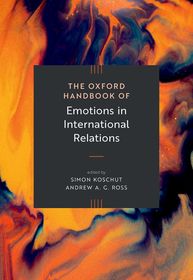
The Oxford Handbook of Emotions in International Relations
Series: Oxford Handbooks;
- Publisher's listprice GBP 127.50
-
57 566 Ft (54 825 Ft + 5% VAT)
The price is estimated because at the time of ordering we do not know what conversion rates will apply to HUF / product currency when the book arrives. In case HUF is weaker, the price increases slightly, in case HUF is stronger, the price goes lower slightly.
- Discount 10% (cc. 5 757 Ft off)
- Discounted price 51 810 Ft (49 343 Ft + 5% VAT)
Subcribe now and take benefit of a favourable price.
Subscribe
57 566 Ft

Availability
Estimated delivery time: In stock at the publisher, but not at Prospero's office. Delivery time approx. 3-5 weeks.
Not in stock at Prospero.
Why don't you give exact delivery time?
Delivery time is estimated on our previous experiences. We give estimations only, because we order from outside Hungary, and the delivery time mainly depends on how quickly the publisher supplies the book. Faster or slower deliveries both happen, but we do our best to supply as quickly as possible.
Product details:
- Publisher OUP USA
- Date of Publication 11 March 2026
- ISBN 9780197698532
- Binding Hardback
- No. of pages546 pages
- Size 254x181x37 mm
- Weight 1070 g
- Language English 686
Categories
Short description:
This handbook explores the groundbreaking ways emotions shape global politics and decision-making. Traditionally, International Relations (IR) overlooked emotions, focusing on rational strategies between nations. However, recent research reveals that emotions such as fear, pride, and anxiety profoundly influence diplomatic, security, and humanitarian decisions. By examining emotions in various contexts, from war and conflict to international law and migration, the book provides fresh insight into why states and leaders act the way they do. It's an essential guide for understanding the growing role of emotions in IR, bridging scholarly insights with real-world applications for today's complex global landscape.
MoreLong description:
Over the past two decades, the study of emotions has emerged as a transformative frontier within International Relations (IR). The Oxford Handbook of Emotions in International Relations aims to capture and contextualize these developments, highlighting how the analysis of emotions has allowed for deeper understandings of international and global politics. The handbook provides a systematic overview, mapping an inherently multi-disciplinary field. Contributions to the volume reveal that emotions are implicated in a variety of processes and practices in IR-including diplomacy, security and conflict, global governance and law, and transnational politics.
The chapters trace the evolution of emotion in IR from “first wave” research on emotions as irrational impulses disrupting decision-making at moments of crisis to “second wave” contributions seeking to investigate the manifold roles emotions play in shaping state behavior and global interactions in practice. The handbook showcases recent scholarship on the influence of emotions across many areas, including human rights and humanitarianism, peace negotiations, transitional justice, climate change, financial crises, political protest, populist movements, and immigration. Through these investigations, the volume offers innovative insights and opens up new questions for the field. Rather than merely asserting that emotions matter, the handbook demonstrates how an analytical focus on emotions can challenge assumptions about rationality and reveal deeper complexities in world politics.
Table of Contents:
Introduction
1. The Emotional Turn in International Relations
Simon Koschut
PART I: Theoretical debates
2. Emotions and Response in a Contingent World
Janice Gross Stein
3. Collective Emotions Beyond the State in Global Politics
Ty Solomon
4. Emotions as Tools for Action
Eric Van Rythoven
5. Empathy and the Politicization of Emotions
Naomi Head
6. Ethical Anxiety in Global Politics
Brent J. Steele
PART II: Actors
7. Leader Convergence and the Emotional Dynamics of Nuclear Crises
Marcus Holmes and Nicholas Wheeler
8. States-As-Groups and State Emotions
Brent E. Sasley
9. Emotions and Expert Authority in Global Governance
Amoz JY Hor and Jittip Mongkolnchaiarunya
10. Excavating the Emotional Nongovernmental Organization
Deepa Prakash
11. Emotions in Terrorism and Political Violence
Stéphane J. Baele and Jérémy Dieudonné
12. The Technological Mediation of Emotions in World Politics
Daniel Møller Ølgaard
PART III: Challenges
13. Emotional Governance and Authoritarian Populism
Catarina Kinnvall
14. Resentment and Grievance
Jelena Subotic
15. The Role of Emotions in Foreign Policy Decision-Making
Payam Ghalehdar
16. Emotions and Interpersonal Diplomacy
Seanon S. Wong
17. Emotional Energy in Conflict, Repression, and Violence
Isabel Bramsen
18. Emotions and Solidarity in the Global South
Lina Benabdallah
19. Nuclear Weapons and Emotion
Michelle Bentley
20. The Emotions in Transitional Justice
Renée Jeffery
21. Emotions and Economic Crises
Wesley W. Widmaier
22. Promises and Limits of Empathy for Global Cooperation
A. Burcu Bayram
23. Climate Emotions
Leonie Holthaus
24. Emotions in Migration Studies
Michelle Pace
PART IV: Concepts
25. Emotions and Ontological Security
Bahar Rumelili and Batur Ozan Togay
26. Power and Emotion in International Relations
Todd H. Hall
27. The Emotional Politics of Status (Mis-)recognition
Élise Rousseau
28. Affect Theory and Global Racial Violence
Alexander Barder
29. Engaging with Emotions in International Law
Anne Saab
30. Feminism, Embodiment, and the Politics of Emotions
Linda Åhäll
31. Emotions and the Visual Representation of Human Suffering
Jessica Auchter
32. Entangled Emotions and Quantum Social
Theory K. M. Fierke
33. Emotions, Colonial Trauma, and Brazil's Desire for International Validation
Erica Resende and Paula Sandrin
PART V: Implications
34. Thinking-Feeling-Doing International Relations Research
Laura J. Shepherd and Laura Sjoberg
35. Emotional Futures and the Future of Emotions in International Relations
Andrew A. G. Ross

