

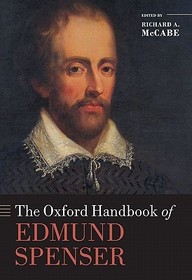
The Oxford Handbook of Edmund Spenser
Series: Oxford Handbooks;
- Publisher's listprice GBP 157.50
-
71 111 Ft (67 725 Ft + 5% VAT)
The price is estimated because at the time of ordering we do not know what conversion rates will apply to HUF / product currency when the book arrives. In case HUF is weaker, the price increases slightly, in case HUF is stronger, the price goes lower slightly.
- Discount 10% (cc. 7 111 Ft off)
- Discounted price 64 000 Ft (60 953 Ft + 5% VAT)
Subcribe now and take benefit of a favourable price.
Subscribe
71 111 Ft

Availability
printed on demand
Why don't you give exact delivery time?
Delivery time is estimated on our previous experiences. We give estimations only, because we order from outside Hungary, and the delivery time mainly depends on how quickly the publisher supplies the book. Faster or slower deliveries both happen, but we do our best to supply as quickly as possible.
Product details:
- Publisher OUP Oxford
- Date of Publication 28 October 2010
- ISBN 9780199227365
- Binding Hardback
- No. of pages832 pages
- Size 249x177x55 mm
- Weight 1650 g
- Language English
- Illustrations 23 black-and-white halftones 0
Categories
Short description:
The Oxford Handbook of Edmund Spenser examines the entire canon of Spenser's work and the social and intellectual environments in which it was produced. It explores technical matters of style, language, and metre, the poet's use of sources and subtexts, and the reception of his work amongst editors, critics, writers, and visual artists.
MoreLong description:
Written by a team of international experts, the forty-two essays in The Oxford Handbook of Edmund Spenser examine the entire canon of Spenser's work and the social and intellectual environments in which it was produced, providing new readings of the texts, extensive analysis of former criticism, and up-to-date bibliographies. Section I, 'Contexts', elucidates the circumstances in which the poetry and prose were written, and suggests some of the major political, social, and professional issues with which the work engages. Section 2, 'Works', presents a series of new readings of the canon informed by the most recent scholarship. Section 3, 'Poetic Craft', provides a detailed analysis of what Spenser termed the poet's 'cunning', the linguistic, rhetorical, and stylistic skills that distinguish his writing. Section 4, 'Sources and Influences', examines a wide range of subtexts, intertexts ,and analogues that contextualise the works within the literary conventions, traditions and genres upon which Spenser draws and not infrequently subverts. Section 5, 'Reception', grapples with the issue of Spenser's effect on succeeding generations of editors, writers, painters, and book-illustrators, while also attempting to identify the most salient and influential strands in the critical tradition. The volume serves as both companion and herald to the Oxford University Press edition of Spenser's Complete Works. No 'agreed' view of Spenser emerges from this work or is intended to. The contributors approach the texts from a variety of viewpoints and employ diverse methods of critical interpretation with a view to stimulating informed discussion and future scholarship.
This volume is a huge undertaking and is to be welcomed for its comprehensive coverage and attention to detail
Table of Contents:
Introduction
Abbreviations
Illustrations
List of contributors
Section 1: Contexts
Spenser's Life
Spenser and Religion
Spenser and Politics
Spenser's Secretarial Career
Spenser's Plantation
Spenser's Patrons and Publishers
Spenser's Biographers
Section 2: Works
A Theatre for Worldlings (1569)
The Shepheardes Calender (1579)
Letters (1580)
The Faerie Queene (1590)
Complaints, Daphnaïda (1591)
Colin Clovts, Astrophel (1595)
Amoretti and Epithalamion (1595)
The Faerie Queene (1596)
Fowre Hymnes, Prothalamion (1596)
A View of the Present State of Ireland (1596, 1633)
Two Cantos of Mutabilitie (1609)
'Lost Works', Suppositious Pieces, and Continuations
Section 3: Poetic Craft
Spenser's Language(s)
Spenser's Metrics
Spenser's Genres
Spenser and Rhetoric
Emblem, Allegory and Symbol
Authorial Self-presentation
Section 4: Sources and Influences
Spenser and the Bible
Spenser and Classical Literature
Spenser and Philosophy
Spenser and Historiography
Spenser, Chaucer and Medieval Romance
Spenser and Neo-Latin Literature
Spenser and Sixteenth-Century Poetics
Spenser and Italian Literature
Spenser and French Literature
Section 5: Reception
Spenser's Textual History
Spenser's Literary Influence
Spenser and the Visual Arts
The Formalist Tradition
The Historicist Tradition
Gender Studies
Psychoanalytical Criticism
Postcolonial Spenser
Index

