

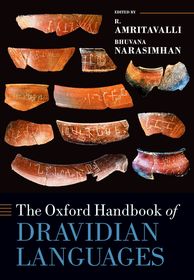
The Oxford Handbook of Dravidian Languages
Series: Oxford Handbooks;
- Publisher's listprice GBP 135.00
-
60 952 Ft (58 050 Ft + 5% VAT)
The price is estimated because at the time of ordering we do not know what conversion rates will apply to HUF / product currency when the book arrives. In case HUF is weaker, the price increases slightly, in case HUF is stronger, the price goes lower slightly.
- Discount 10% (cc. 6 095 Ft off)
- Discounted price 54 857 Ft (52 245 Ft + 5% VAT)
Subcribe now and take benefit of a favourable price.
Subscribe
60 952 Ft

Availability
Not yet published.
Why don't you give exact delivery time?
Delivery time is estimated on our previous experiences. We give estimations only, because we order from outside Hungary, and the delivery time mainly depends on how quickly the publisher supplies the book. Faster or slower deliveries both happen, but we do our best to supply as quickly as possible.
Product details:
- Publisher OUP USA
- Date of Publication 3 July 2026
- ISBN 9780197610411
- Binding Hardback
- No. of pages654 pages
- Size 248x182x44 mm
- Weight 1270 g
- Language English 700
Categories
Short description:
The Oxford Handbook of Dravidian Languages offers an accessible introduction to Dravidian languages and linguistics from a broad interdisciplinary perspective. The text examines the languages through studies that highlight their long histories, vast literatures, and current robust presence in communication. Beyond formal linguistics, the chapters cover diverse areas of inquiry such as cognition and conceptual representation, comparative philology, language and politics, lexicology, literature and literary history, and multilingualism. This Handbook compiles current, trend-setting scholarship in Dravidian studies, exploring the origins of the Dravidian peoples, their languages, and the history of script in the Indian subcontinent.
MoreLong description:
The Dravidian languages of south India, spoken by approximately 222 million speakers across South Asia, form one of the largest language families in the world. First recognized as a distinct group in the early-to-mid 19th century, the pioneering scholarship on Dravidian languages emerged in the 1970s within the Generative Linguistics paradigm. Half a century later, the body of scholarship on Dravidian languages, employing varied analytical frameworks, serves to deepen our understanding of this unique linguistic family.
The Oxford Handbook of Dravidian Languages offers an accessible introduction to Dravidian languages and linguistics from a broad interdisciplinary perspective. The text examines the languages through studies that highlight their long histories, vast literatures, and current robust presence in communication. Beyond formal linguistics, the chapters cover diverse areas of inquiry such as cognition and conceptual representation, comparative philology, language and politics, lexicology, literature and literary history, and multilingualism. This Handbook compiles current, trend-setting scholarship in Dravidian studies, exploring the origins of the Dravidian peoples, their languages, and the history of script in the Indian subcontinent.
Table of Contents:
1. Introduction to The Oxford Handbook of Dravidian Languages
R. Amritavalli and Bhuvana Narasimhan
2. The Dravidian Languages: An Overview
Suresh Kolichala
Section I. Formal Analyses
3. Dravidian Word Order and the Clausal Peripheries
K. A. Jayaseelan
4. Perspectival Anaphora: a Case Study From Tamil
Sandhya Sundaresan
5. Allocutive Agreement in Dravidian
Thomas McFadden
6. Fine-tuning the Dravidian Left Periphery: The Three "Complementisers" in Telugu
Rahul Balusu
7. Genericity, Quantification, and Modality in Malayalam: The Many Faces of -Um and -Unnu
Hany Babu M. T.
8. Gradability and Comparison in Kannada
Sindhu Herur and R. Amritavalli
Section II. Traditional And Contemporary Language Studies
9. Correlative Structures in Dravidian
Sanford Steever
10. Asyndetic Conditional Clauses in Brahui
Masato Kobayashi and Liaquat Ali
11. Verb base alternations in Betta Kurumba
Gail Coelho
12. Agreement in Malto Conjunctive Participles
Masato Kobayashi
Section III. Language Processing, Acquisition, And Impairment
13. Psycholinguistic studies in Dravidian languages
Bhuvana Narasimhan and Annu Kurian-Mathew
14. Electrophysiological Investigations of Sentence Processing in Tamil
R. Muralikrishnan
15. The Acquisition of Differential Object-Marking in Tamil
Annu Kurian-Mathew and Bhuvana Narasimhan
16. Dravidian Contributions to the Theory of Language Acquisition
Jeffrey Lidz
17. The Acquisition of Negation and Finiteness in Tamil
R. Amritavalli
18. Possible Morphosyntactic Markers of Specific Language Impairment in Kannada
Shivani Tiwari, Pratibha Karanth and R. Amritavalli
19. Inflections in Home and School Languages
Madhavi Gayathri Raman
20. Malayalam and Core Dravidian Phonology: A View from Early Language Acquisition
Gayathri G. Krishnan, Arathi Raghunathan, and Vaijayanthi M. Sarma
Section IV. Literary Creativity and Languages in Contact
21. The World of the Tamil Sangam Poetry
Manu V. Devadevan
22. The Trajectory of Tamil in Cinema
Swarnavel Eswaran
23. The Tamil Response to Cosmopolitan Languages in Contact
E. Annamalai and T. Sriraman
24. Syntactic Maintenance of Tamil Relative Clauses in Multilingual Adolescents
Usha Lakshmanan
25. Multilingualism in the Evolution of Dravidian Languages
S. N. Sridhar
Section V. Literacy and Lexicography
26. From Brahmi to Early Kannada: Script, Scribes, and their Society
S. Settar
27. Literacy and its Acquisition in Kannada
Sonali Nag
28. Currents in Tamil Lexicography
Gregory James and V. Jayadevan
29. The Legacy of Kannada Dictionaries
S. L. Srinivasa Murthy
Index

