

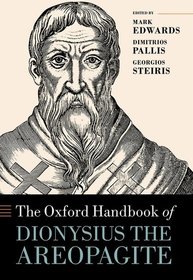
The Oxford Handbook of Dionysius the Areopagite
Series: Oxford Handbooks;
- Publisher's listprice GBP 165.00
-
74 497 Ft (70 950 Ft + 5% VAT)
The price is estimated because at the time of ordering we do not know what conversion rates will apply to HUF / product currency when the book arrives. In case HUF is weaker, the price increases slightly, in case HUF is stronger, the price goes lower slightly.
- Discount 10% (cc. 7 449 Ft off)
- Discounted price 67 048 Ft (63 855 Ft + 5% VAT)
Subcribe now and take benefit of a favourable price.
Subscribe
74 497 Ft

Availability
printed on demand
Why don't you give exact delivery time?
Delivery time is estimated on our previous experiences. We give estimations only, because we order from outside Hungary, and the delivery time mainly depends on how quickly the publisher supplies the book. Faster or slower deliveries both happen, but we do our best to supply as quickly as possible.
Product details:
- Publisher OUP Oxford
- Date of Publication 25 February 2022
- ISBN 9780198810797
- Binding Hardback
- No. of pages752 pages
- Size 252x176x43 mm
- Weight 1428 g
- Language English 275
Categories
Short description:
This handbook brings together forty chapters on the antecedents, the content, and the reception of the Dionysian corpus, a body of writings falsely ascribed to Dionysius the Areopagite, a convert of St. Paul, but actually written in around 500 A.D.
MoreLong description:
This Handbook contains forty essays by an international team of experts on the antecedents, the content, and the reception of the Dionysian corpus, a body of writings falsely ascribed to Dionysius the Areopagite, a convert of St Paul, but actually written about 500 AD. The first section contains discussions of the genesis of the corpus, its Christian antecedents, and its Neoplatonic influences. In the second section, studies on the Syriac reception, the relation of the Syriac to the original Greek, and the editing of the Greek by John of Scythopolis are followed by contributions on the use of the corpus in such Byzantine authors as Maximus the Confessor, John of Damascus, Theodore the Studite, Niketas Stethatos, Gregory Palamas, and Gemistus Pletho. In the third section attention turns to the Western tradition, represented first by the translators John Scotus Eriugena, John Sarracenus, and Robert Grosseteste and then by such readers as the Victorines, the early Franciscans, Albert the Great, Aquinas, Bonaventure, Dante, the English mystics, Nicholas of Cusa, and Marsilio Ficino. The contributors to the final section survey the effect on Western readers of Lorenzo Valla's proof of the inauthenticity of the corpus and the subsequent exposure of its dependence on Proclus by Koch and Stiglmayr. The authors studied in this section include Erasmus, Luther and his followers, Vladimir Lossky, Hans Urs von Balthasar, and Jacques Derrida, as well as modern thinkers of the Greek Church. Essays on Dionysius as a mystic and a political theologian conclude the volume.
The Oxford Handbook of Dionysius the Areopagite surely represents one of the most complete and variegated texts on the reception of Dionysius we have at our disposal in scholarship, also managing to give the readers a consistent overview of the philosophy and theology of the author.
Table of Contents:
Introduction
Part I: The Corpus in its Historical Setting
The Dionysian Corpus
Content of the Dionysian Corpus
Dionysius the Areopagite and the New Testament
Christian Apophaticism before Dionysius
Philo and Clement of Alexandria
Origen, Evagrius, and Dionysius
Dionysius and Gregory of Nyssa
Dionysius, Iamblichus, and Proclus
God in Dionysius and the Later Neoplatonists
Part II: Dionysius in the East
Dionysius the Areopagite in Syriac: The Translation of Sergius of Resh'ayna (Sixth Century)
Notes on the Earliest Greco-Syriac Reception of the Dionysian Corpus
John of Scythopolis and the Dionysian Corpus
Maximus the Confessor and the Reception of Dionysius the Areopagite
Dionysius and John of Damascus
Theodore the Studite and Dionysius
Dionysius from Niketas Stethatos to Gregory the Sinaite (and Gregory Palamas)
Gregory Palamas and Dionysius
Pletho and Dionysius
Part III: Dionysius in the West
Occulti Manifestatio: the Journey to God in Dionysius and Eriugena
John Sarracenus and his Influence
Robert Grosseteste, Translator of Dionysius
Bonaventure and Dionysius
Hugh of St Victor and Dionysius
Thomas Gallus: Affective Dionysianism
Dionysius in Albertus Magnus and his Student Thomas Aquinas
Dionysius in Dante
The Carthusians and the Cloud of Unknowing
Dionysius the Areopagite and Nicholas of Cusa
Marsilio Ficino and the Dionysian Corpus
Part IV
Valla and Erasmus on the Dionysian Question
Luther on Dionysius
Dionysius and the Lutheran Tradition
Dionysius' Reception in the English-Speaking World
Hugo Koch and Josef Stiglmayr on Dionysius and Proclus
Three Theologians: Dean Inge, Vladimir Lossky, and Von Balthasar
The Receptoin of Dionysius in Modern Greek Theology and Scholarship
Jacques Derrida and Jean-Luc Marion
Dionysius as a Mystic
On the Theology of Dionysius

