

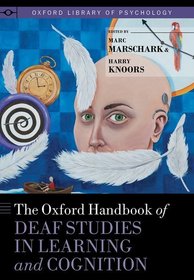
The Oxford Handbook of Deaf Studies in Learning and Cognition
Series: Oxford Library of Psychology;
- Publisher's listprice GBP 112.50
-
50 793 Ft (48 375 Ft + 5% VAT)
The price is estimated because at the time of ordering we do not know what conversion rates will apply to HUF / product currency when the book arrives. In case HUF is weaker, the price increases slightly, in case HUF is stronger, the price goes lower slightly.
- Discount 10% (cc. 5 079 Ft off)
- Discounted price 45 714 Ft (43 538 Ft + 5% VAT)
Subcribe now and take benefit of a favourable price.
Subscribe
50 793 Ft

Availability
Only to order.
Why don't you give exact delivery time?
Delivery time is estimated on our previous experiences. We give estimations only, because we order from outside Hungary, and the delivery time mainly depends on how quickly the publisher supplies the book. Faster or slower deliveries both happen, but we do our best to supply as quickly as possible.
Product details:
- Publisher OUP USA
- Date of Publication 24 July 2020
- ISBN 9780190054045
- Binding Hardback
- No. of pages480 pages
- Size 183x257x30 mm
- Weight 980 g
- Language English 23
Categories
Short description:
The Oxford Handbook of Deaf Studies in Learning and Cognition focuses exclusively on learning, cognition, and cognitive development with regard to deaf individuals from theoretical, psychological, biological, linguistic, social-emotional, and educational perspectives. Each chapter includes state-of-the-art research conducted and reviewed by international experts in the area. Drawing this research together, this volume allows for a synergy of ideas that possesses the potential to move research, theory, and practice forward.
MoreLong description:
In recent years, the intersection of cognitive psychology, developmental psychology, and neuroscience with regard to deaf individuals has received increasing attention from a variety of academic and educational audiences. Both research and pedagogy have addressed questions about whether deaf children learn in the same ways that hearing children learn, how signed languages and spoken languages might affect different aspects of cognition and cognitive development, and the ways in which hearing loss influences how the brain processes and retains information. There are now a number of preliminary answers to these questions, but there has been no single forum in which research into learning and cognition is brought together.
The Oxford Handbook of Deaf Studies in Learning and Cognition aims to provide this shared forum, focusing exclusively on learning, cognition, and cognitive development from theoretical, psychological, biological, linguistic, social-emotional, and educational perspectives. Each chapter includes state-of-the-art research conducted and reviewed by international experts in the area. Drawing this research together, this volume allows for a synergy of ideas that possesses the potential to move research, theory, and practice forward.
The Oxford Handbook of Deaf Studies in Learning and Cognition provides a comprehensive, well-documented review of current research. ... Among the important and sometimes controversial topics they discuss are the various factors impacting learning for DHH individuals, including the use (or non-use) of sign language, early detection and intervention, and cochlear implants. This handbook is recommended for researchers interested in cognitive psychology, child development, and education, and how these fields may be informed by the experiences of DHH people, young children in particular.
Table of Contents:
Contents
Preface
Deaf Studies in Learning and Cognition: A Coming-of-Age Story
Marc Marschark and Harry Knoors
Part One: Language, Learning, and Cognition
1. Foundations of Language Development in Deaf and Hard-of-hearing Infants: Cognitive and Social Processes
Dani Levine, Daniela Avelar, Roberta Michnick Golinkoff, Derek Houston, and Kathy Hirsh-Pasek
2. Developmental, Cognitive, and Neurocognitive Perspectives on Language Development in Children Who Use Cochlear Implants
Pasquale Rinaldi, Francesco Pavani, and Maria Cristina Caselli
3. Investigating Early Preimplant Predictors of Language and Cognitive Development in Children With Cochlear Implants
Mary K. Fagan, Laurie S. Eisenberg, and Karen C. Johnson
4. The Effect of Communication Mode on Learning Outcomes for Children With Severe-Profound Hearing Loss
Julia Sarant and Ann Geers
Part Two: Cognition and Language: Foundations and Outcomes
5. It Is More Than Language: The Role of Cognition in the Pragmatic Skills of Children Who Are Deaf or Hard-of-hearing
Dianne Toe, Louise Paatsch, and Amy Szarkowski
6. Dissociating the Impact of Auditory Access and Language Access in Deaf Children's Cognitive Development
Matthew Hall
7. How Early Auditory Experience Affects Children's Ability to Learn Spoken Words
Derek Houston, Chi-Hsin Chen, Claire Monroy, and Irina Castellanos
8. Triggering, Configuration, and Engagement: Spoken Word Learning Processes in Young Children With Hearing Loss
Emily Lund
9. Bilingual Cognitive Advantages in Multilingual and Multimodal Deaf and Hard-of-hearing Children and Adults
Kathryn Crowe and Linda Cupples
10. I Should Do as I Say, Not as I Do: Self-regulation and Psychosocial Outcomes in Deaf Children With Cochlear Implants
Irina Castellanos, David B. Pisoni, and William G. Kronenberger
Part Three: Learning and Cognition in Development
11. Verbal Learning and Memory Processes After Cochlear Implantation
David B. Pisoni, William G. Kronenberger, Michael S. Harris, and Aaron C. Moberly
12. Cognitive Development: The Impact of Pediatric Cochlear Implantation
Lindsey Edwards and Peter Isquith
13. Theory of Mind and Conversation in Deaf and Hearing Children
Candida C. Peterson
14. Theory of Mind: Implications for Cognition and Learning in Deaf and Hard-of-hearing Learners
Stacey Tucci and Susan Easterbrooks
15. Why Are Children With Cochlear Implants at Risk for Executive Functioning Delays: Language Only or Something More?
William G. Kronenberger and David B. Pisoni
16. Executive Functions and Access to Language: The Importance of Intersubjectivity
Gary Morgan and Matt Dye
17. Working Memory for Signs and Gestures
Mary Rudner and Jerker Rönnberg
Part Four: Cognition and Literacy
18. Executive Function, Memory, and Literacy in Deaf Learners: Reading and Writing Involve More Than Just Words and Grammar
Donna Morere
19. The Influence of Explicit and Implicit Memory Processes on the Spoken-Written Language Learning of Children With Cochlear Implants
Barbara Arfé and Ambra Fastelli
20. Changing Perspectives for the 21st Century: Digital Literacy and Computational Thinking for Deaf/Hard-of-hearing Learners
Karen L. Kritzer and Chad Smith
21. The Neurobiology of Reading Differs for Deaf and Hearing Adults
Karen Emmorey
Part Five: Learning and Cognition in the Real World
22. Framing Educational Needs of Deaf and Hard-of-Hearing Infants and Toddlers Using the Developmental Systems Approach
Manfred Hintermair
23. Making "Normal" Count: Mediating for Early Mathematics Learning in Young Deaf and Hard-of-hearing Children
Karen L. Kritzer
24. Tickets for the Inclusive Museum: Accessible Opportunities for Nonformal Learning by Deaf and Hard-of-hearing Individuals
Magda Nikolaraizi, Charikleia Kanari, and Marc Marschark
25. Technology Makes Things Possible: Improving the Abilities of Deaf and Hard-of-hearing Children with Advanced Technologies
Sigal Eden
26. Accommodating Deaf and Hard of Hearing Children With Cognitive Deficits
Harry Knoors and Marc Marschark
Index

