

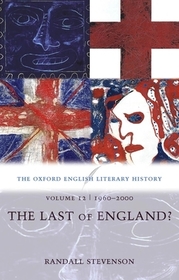
The Oxford English Literary History: Volume 12: 1960-2000: The Last of England?
Series: Oxford English Literary History; 12;
- Publisher's listprice GBP 45.99
-
20 764 Ft (19 775 Ft + 5% VAT)
The price is estimated because at the time of ordering we do not know what conversion rates will apply to HUF / product currency when the book arrives. In case HUF is weaker, the price increases slightly, in case HUF is stronger, the price goes lower slightly.
- Discount 10% (cc. 2 076 Ft off)
- Discounted price 18 687 Ft (17 798 Ft + 5% VAT)
Subcribe now and take benefit of a favourable price.
Subscribe
20 764 Ft

Availability
printed on demand
Why don't you give exact delivery time?
Delivery time is estimated on our previous experiences. We give estimations only, because we order from outside Hungary, and the delivery time mainly depends on how quickly the publisher supplies the book. Faster or slower deliveries both happen, but we do our best to supply as quickly as possible.
Product details:
- Edition number and title :Volume 12: 1960-2000: The Last of England?
- Edition number New ed.
- Publisher OUP Oxford
- Date of Publication 10 November 2005
- ISBN 9780199288359
- Binding Paperback
- No. of pages644 pages
- Size 217x137x32 mm
- Weight 926 g
- Language English
- Illustrations 15 halftones 0
Categories
Short description:
Comprehensively charting developments in the literary field since 1960, Randall Stevenson pinpoints the origins of literary change in the historical, social, and intellectual pressures of the times - to shadows of war and loss of empire; declining influences of class; shifting relations between the genders; emergent minority and counter-cultures; and the broadening democratisation of contemporary life in general. Lucid, accessible, and engaging, this volume of the Oxford English Literary History presents a unique illumination of its age - one we have lived through, but are just beginning to understand. The first full account of its period, it will set the agenda for discussion of late twentieth-century literature for many years to come.
MoreLong description:
English Literature in the 1960s soon threw off its post-war weariness and the tepid influences of the previous decade. New voices, new visions, and new commitments profoundly reshaped writing during the sixties, and throughout the rest of the century. Drama thrived on its rapidly rebuilt foundations. New freedoms of style and form revitalised fiction. Poetry, too, gradually recovered the variety and inventiveness of earlier years.
As well as comprehensively charting these changes in the literary field, Randall Stevenson persuasively pinpoints their origins in the historical, social, and intellectual pressures of the times. Literary developments are revealingly related to the wider evolution and profound changes in English experience in the late twentieth century - to shadows of war and loss of empire; declining influences of class; shifting relations between the genders; emergent minority and counter-cultures; and the broadening democratization of contemporary life in general.
Analyses of the rise of literary theory, of publishing and the book trade, and of the pervasive influences of modernism and postmodernism contribute further to an impressively thorough, insightful description of writing in the later twentieth century - a literary period Stevenson shows to be far more imaginative and exciting than has yet been recognized. Lucid, accessible, and engaging, this volume of the Oxford English Literary History presents a unique illumination of its age - one we have lived through, but are only just beginning to understand. The first full account of its period, it will set the agenda for discussion of late twentieth-century literature for many years to come.
For much of the period covered here the literature of England was dogged by an all-pervading sense of failure and decline. In Stevenson's analysis, a "misplaced nostalgia" impeded the progress of English drama, fiction and especially poetry. Philip Larkin mourned an "England gone", and he cast a long shadow over English verse. "English literature was never more static than under the influence of the Movement," says Stevenson. "If the later 20th century proved a difficult period for poetry, it was in large measure because it took so long to realise this, and move on."
Table of Contents:
Introduction: Last Things First
I. Histories
'Gleaming Twilight': Literature, Culture, and Society
A Postmodern Age? Literature, Ideas, and Traditions
An Age of Theory? Critics, Readers, and Authors
A Golden Age? Readers, Authors, and the Book Trade
II. Poetry
Movement or Revival: The late 1950s to the 1980s
Counter-movements and Modernist Memories: 1960 to the 1980s
Politics and Postmodernism: The Late 1970s to 2000
Rosebay Revived: Language, Form, and Audience for 'This Unpopular Art'
III. Drama
A Public Art Form: The late 1950s to the 1970s
Last Year in Jerusalem: Politics and Performance after 1968
'Real Revolutionaries': Politics and the Margins
Absurdism, Postmodernism, Individualism
Discovering the Body
Revolution, Television, Subsidy
IV. Narrative
To the Crossroads: Style and Society in the 1960s and 1970s
A Darker Route: Morality and History in the 1960s and 1970s
Longer Shadows and Darkness Risible: The 1970s to 2000
'Double Lives': Women's Writing and Gender Difference
'The Century of Strangers': Travellers and Migrants
Genres, Carnivals, and Conclusions
Author Bibliographies
Suggestions for Further Reading
Preface
I. Histories
'Gleaming Twilight' - Literature, Culture, and Society
A Postmodern Age? - Literature, Ideas, and Traditions
An Age of Theory? - Critics, Readers, and Authors
A Golden Age? - Readers, Authors, and the Book Trade
II. Poetry
Movement or Revival - the late 1950s to the 1980s
Movements and Counter-Movements - the 1960s to the 1980s
Politics and Postmodernism - the late 1970s to 2000
Rosebay Revived - Language, Form, and Audience for 'This Unpopular Art'
III. Drama
A Public Art Form - the late 1950s to the 1970s
Last Year in Jerulsalem - Politics and Performance after 1968
'Real Revolutionaries' - Politics and the Margins
Absurdism, Postmodernism, Individualism
Discovering the Body
Revolution, Television, Subsidy
IV. Narrative
To the Crossroads - Style and Society in the 1960s and 1970s
A Darker Route - Moral and Historical Vision in the 1960s and 1970s
Longer Shadows and Darkness Risible - the 1970s to 2000
'Double Lives' - Women's Writing and Gender Difference
'The Century of Strangers' - Travellers and Migrants
Genres, Carnivals, and Conclusions
Author Bibliographies
Suggestions for Further Reading
Works Cited
Index

