

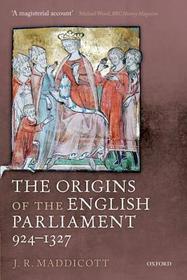
The Origins of the English Parliament, 924-1327
- Publisher's listprice GBP 33.49
-
15 999 Ft (15 237 Ft + 5% VAT)
The price is estimated because at the time of ordering we do not know what conversion rates will apply to HUF / product currency when the book arrives. In case HUF is weaker, the price increases slightly, in case HUF is stronger, the price goes lower slightly.
- Discount 10% (cc. 1 600 Ft off)
- Discounted price 14 399 Ft (13 713 Ft + 5% VAT)
Subcribe now and take benefit of a favourable price.
Subscribe
15 999 Ft

Availability
printed on demand
Why don't you give exact delivery time?
Delivery time is estimated on our previous experiences. We give estimations only, because we order from outside Hungary, and the delivery time mainly depends on how quickly the publisher supplies the book. Faster or slower deliveries both happen, but we do our best to supply as quickly as possible.
Product details:
- Publisher OUP Oxford
- Date of Publication 23 February 2012
- ISBN 9780199645343
- Binding Paperback
- No. of pages544 pages
- Size 232x155x28 mm
- Weight 812 g
- Language English 0
Categories
Short description:
A magisterial study of the evolution of the English parliament from its earliest origins in the late Anglo-Saxon period through to the fully fledged parliament of lords and commons which sanctioned the deposition of Edward II in 1327.
MoreLong description:
The Origins of the English Parliament is a magisterial account of the evolution of parliament, from its earliest beginnings in the late Anglo-Saxon period. Starting with the national assemblies which began to meet in the reign of King Æthelstan, it carries the story through to the fully fledged parliament of lords and commons of the early fourteenth century, which came to be seen as representative of the whole nation and which eventually sanctioned the deposition of the king himself in 1327.
Throughout, J. R. Maddicott emphasizes parliament's evolution as a continuous process, underpinned by some important common themes. Over the four hundred years covered by the book the chief business of the assembly was always the discussion of national affairs, together with other matters central to the running of the state, such as legislation and justice. It was always a resolutely political body. But its development was also shaped by a series of unforeseen events and episodes. Chief among these were the Norman Conquest, the wars of Richard I and John, and the minority of Henry III. A major turning-point was reached in 1215, when Magna Carta established the need for general consent to taxation - a vital step towards the establishment of parliament itself in the next generation.
Covering an exceptionally long time span, The Origins of the English Parliament takes readers to the roots of the English state's central institution, showing how the more familiar parliament of late medieval and early modern England came into being and illuminating the close relationship between particular political episodes and the course of institutional change. Above all, it shows how the origins of parliament lie not in the late thirteenth and early fourteenth centuries, as has usually been argued, but in a much more distant past.
its wide and profound scholarship has much to teach us about the roots and functions of an institution now subjected to so much unhistorical criticism.
Table of Contents:
Genesis: 'The Witan of the English People, c.920-1066
Confluence: English Council, Feudal Counsel, 1066-1189
Transformation: The Making of the Community of the Realm, 1189-1327
Establishment: The First Age of Parliamentary Politics, 1227-58
Consolidation: Parliament and Baronial Reform, 1258-72
Expansion: Parliament and Nation, 1272-1327
English Exceptionalism? The Peculiarities of the English Parliament. Conclusion
Appendix: A List of Parliaments, 1235-57
Bibliography
Index

