

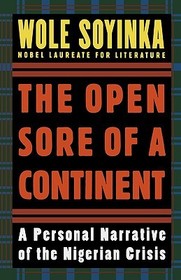
The Open Sore of a Continent
A Personal Narrative of the Nigerian Crisis
Series: W.E.B. Du Bois Institute;
- Publisher's listprice GBP 15.49
-
6 993 Ft (6 660 Ft + 5% VAT)
The price is estimated because at the time of ordering we do not know what conversion rates will apply to HUF / product currency when the book arrives. In case HUF is weaker, the price increases slightly, in case HUF is stronger, the price goes lower slightly.
- Discount 10% (cc. 699 Ft off)
- Discounted price 6 294 Ft (5 994 Ft + 5% VAT)
Subcribe now and take benefit of a favourable price.
Subscribe
6 993 Ft

Availability
printed on demand
Why don't you give exact delivery time?
Delivery time is estimated on our previous experiences. We give estimations only, because we order from outside Hungary, and the delivery time mainly depends on how quickly the publisher supplies the book. Faster or slower deliveries both happen, but we do our best to supply as quickly as possible.
Product details:
- Publisher OUP USA
- Date of Publication 20 November 1997
- ISBN 9780195119213
- Binding Paperback
- No. of pages176 pages
- Size 216x140x10 mm
- Weight 227 g
- Language English 0
Categories
Short description:
From the moment, on November 10, 1995, that the Nigerian military government executed dissident writer Ken Saro-Wiwa along with eight other activists, Nigeria became an outcast in the global village. The events that led up to Saro-Wiwa's execution mark Nigeria's decline from a post-colonial success story to its current military dictatorship, and few writers have been more outspoken in decrying and lamenting this decline than Nobel Prize laureate and Nigerian exile Wole Soyinka. In The Open Sore of a Continent, Soyinka, whose own Nigerian passport was confiscated 1994, explores the history and future of Nigeria in a compelling jeremiad that is as intense as it is provocative, learned, and wide-ranging.
MoreLong description:
On November 10, 1995, the Nigerian military government under General Sani Abacha executed dissident writer Ken Saro-Wiwa along with eight other activists, and the international community reacted with outrage. The response was quick, decisive, and nearly unanimous: Nigeria is an outcast in the global village. The events that led up to Saro-Wiwa's execution mark Nigeria's decline from a post-colonial success story to its current military dictatorship, and few writers have been more outspoken in decrying and lamenting this decline than Nobel Prize laureate and Nigerian exile Wole Soyinka.
In The Open Sore of a Continent, Soyinka, whose own Nigerian passport was confiscated 1994, explores the history and future of Nigeria in a compelling jeremiad that is as intense as it is provocative, learned, and wide-ranging. He deftly explains the shifting dramatis personae of Nigerian history and politics , arguing that `a glance at the mildewed tapestry of the stubbornly unfinished nation edifice' is necessary to explain where Nigeria can go next.
In the process of elucidating the Nigerian crisis, Soyinka opens readers to the broader questions of nationhood, identity, and the general state of African culture and politics at the end of the twentieth century. He examines the different ways in which a nation can be defined, and asks how these varying definitions impact the people who live under them? Soyinka concludes with a resounding call for international attention to this question: the global community must address the issue of nationhood to prevent further religious mandates and calls for ethnic purity of the sort that have turned Algeria, Rwanda, Bosnia, and Sri Lanka into killing fields.
a great work by a great writer on the grave travails of a potentially great nation

