

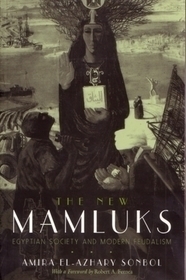
The New Mamluks
Egyptian Society and Modern Feudalism
Series: Middle East Studies Beyond Dominant Paradigms;
- Publisher's listprice GBP 14.99
-
6 767 Ft (6 445 Ft + 5% VAT)
The price is estimated because at the time of ordering we do not know what conversion rates will apply to HUF / product currency when the book arrives. In case HUF is weaker, the price increases slightly, in case HUF is stronger, the price goes lower slightly.
- Discount % (cc. 0 Ft off)
- Discounted price 0 Ft (0 Ft + 5% VAT)
Subcribe now and take benefit of a favourable price.
Subscribe
6 767 Ft

Availability
Out of print
Why don't you give exact delivery time?
Delivery time is estimated on our previous experiences. We give estimations only, because we order from outside Hungary, and the delivery time mainly depends on how quickly the publisher supplies the book. Faster or slower deliveries both happen, but we do our best to supply as quickly as possible.
Product details:
- Edition number New
- Publisher Syracuse University Press
- Date of Publication 1 December 2000
- Number of Volumes Paperback
- ISBN 9780815628453
- Binding Paperback
- No. of pages272 pages
- Size 229x153x18 mm
- Weight 480 g
- Language English 0
Categories
Short description:
"This study of modern Egypt aims to open the debate regarding new terms and methods for understanding the Middle East and Islamic societies. Sonbol shows continuity in the division of Egyptian society into two groups: the """"Khassa"""" which tried to impose a hegemonic culture, and the opposing """"Amma""""."
MoreLong description:
This study of modern Egypt opens the debate regarding new terms and methods for understanding the Middle East and Islamic societies. Amira el-Azhary Sonbol has produced an analytical history of Egypt from the time before Muhammad Ali to the present day. Using local idioms and terms such as khassa and 'amma, iltazim and fa'iz, she has developed a methodology that is more meaningful because it ties events of the eighteenth century to those of the twentieth.
The author explores the division that has existed in modern Egyptian society between two groups: the khassa, a ruling elite that tried to impose a hegemonic culture that reflected and encouraged its own economic interests, and the 'amma, the masses who clung to their heritage and customs in an attempt to acquire a share of the wealth.
Sonbol discusses today's Islamic movement in Egypt as a revolution correcting the duality of culture that was brought about by historical events like colonialism and the importation of exogenous ideologies. She suggests a different way of looking at culture and the necessity of seeing cultural struggle as a method for studying the historical process that goes beyond the political and economical.

