

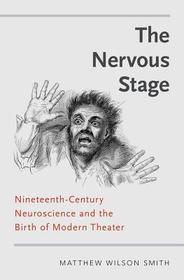
The Nervous Stage
Nineteenth-century Neuroscience and the Birth of Modern Theatre
- Publisher's listprice GBP 46.99
-
22 449 Ft (21 380 Ft + 5% VAT)
The price is estimated because at the time of ordering we do not know what conversion rates will apply to HUF / product currency when the book arrives. In case HUF is weaker, the price increases slightly, in case HUF is stronger, the price goes lower slightly.
- Discount 10% (cc. 2 245 Ft off)
- Discounted price 20 204 Ft (19 242 Ft + 5% VAT)
Subcribe now and take benefit of a favourable price.
Subscribe
22 449 Ft

Availability
printed on demand
Why don't you give exact delivery time?
Delivery time is estimated on our previous experiences. We give estimations only, because we order from outside Hungary, and the delivery time mainly depends on how quickly the publisher supplies the book. Faster or slower deliveries both happen, but we do our best to supply as quickly as possible.
Product details:
- Publisher OUP USA
- Date of Publication 16 November 2017
- ISBN 9780190644086
- Binding Hardback
- No. of pages238 pages
- Size 157x239x25 mm
- Weight 476 g
- Language English 0
Categories
Short description:
The Nervous Stage examines the relations between theatrical practices and the scientific study of the nervous system.
MoreLong description:
Nineteenth-century investigations into the nervous system produced extraordinary discoveries that changed ways of thinking far beyond the scientific community. Over the course of the century, scientists began to conceive of the subject not principally as soul, mind, or even brain, but instead as a complex of organically interacting mechanisms, many of them operating more or less autonomously and unconsciously. Meanwhile, theatrical works of the time by Shelley, Wagner, Dickens, Buchner, Zola, and Strindberg, sought to play directly on the nerves of the spectators through non-representational means, comprising a coherent genre Matthew Wilson Smith has dubbed the "theaters of sensation."
The Nervous Stage examines the relations between theatrical practices and the scientific study of the nervous system, arguing that to a significant degree, modern theater emerged out of the interaction between these two apparently disparate fields. In six chapters, The Nervous Stage makes three fundamental contributions to scholarship on comparative literature, specifically in the areas of drama/performance, cognitive literary studies, and the beginnings of global modernism. Through a series of revisionist readings of specific theatrical works and artists, Smith demonstrates that a number of literary texts were deeply engaged in dialogue with the neurological sciences of their period, and that an appreciation of this dialogue helps us better to understand their significance for their own historical period as well as for our own. Furthermore, it argues that a number of lesser-known works--ranging from certain "closet dramas" such as Shelley's The Cenci to popular melodramas such as Augustin Daly's Under the Gaslight--had much greater cultural significance than has been acknowledged heretofore.
The book's nuanced and profound exploration of how emerging neurophysiological ideas intertwined with performance both onstage and off makes this text essential reading to anyone interested in the medicalized subject or in the effect of neuroscience uponthe cultural history of Western Europe.
Table of Contents:
Introduction
Chapter 1: The Emptying of Gesture: Neurology and the British Romantic Stage
Chapter 2: From Gestures to Nerves: Woyzeck and the Barbel Fish
Chapter 3: The Nervous System: Melodrama, Railway Trauma, and Systemic Risk
Chapter 4: The Inner Drama of the Body: Wagner's Neural Aesthetics
Chapter 5: Theatre's Revenge: Charcot and the Grand Guignol
Chapter 6: The Prison-house of Nerves: Zola and Strindberg
Conclusion

