

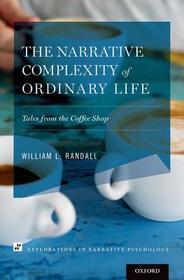
The Narrative Complexity of Ordinary Life
Tales from the Coffee Shop
Series: Explorations in Narrative Psychology;
- Publisher's listprice GBP 75.00
-
33 862 Ft (32 250 Ft + 5% VAT)
The price is estimated because at the time of ordering we do not know what conversion rates will apply to HUF / product currency when the book arrives. In case HUF is weaker, the price increases slightly, in case HUF is stronger, the price goes lower slightly.
- Discount 10% (cc. 3 386 Ft off)
- Discounted price 30 476 Ft (29 025 Ft + 5% VAT)
Subcribe now and take benefit of a favourable price.
Subscribe
33 862 Ft

Availability
printed on demand
Why don't you give exact delivery time?
Delivery time is estimated on our previous experiences. We give estimations only, because we order from outside Hungary, and the delivery time mainly depends on how quickly the publisher supplies the book. Faster or slower deliveries both happen, but we do our best to supply as quickly as possible.
Product details:
- Publisher OUP USA
- Date of Publication 8 October 2015
- ISBN 9780199930432
- Binding Hardback
- No. of pages210 pages
- Size 155x239x20 mm
- Weight 431 g
- Language English 0
Categories
Short description:
In The Narrative Complexity of Ordinary Life, William L. Randall shows how narrative psychology is integral to how we navigate everyday life. He makes the case that all people function as narrative psychologists by continually storying their lives--as well as those of others--in memory and imagination.
MoreLong description:
Our everyday lives are enmeshed in storytelling: the stories we tell about our memories, the people we know, and the world we inhabit; those we tell about our families and communities; and the narratives we encounter in books, movies, and television. Narrative structures how we view ourselves and everything around us.
In The Narrative Complexity of Ordinary Life, William L. Randall shows how concepts central to the study of narrative psychology--such as narrative development and the interrelation between narrative and identity, cognition, and development--are integral to everyday life. He makes the case that all people function as narrative psychologists by continually storying their lives in memory and imagination, as well as speculating on the stories that others may be living, a process that Randall refers to as storyotyping.
Relying heavily on narrative, Randall draws from experiences in his own life to illustrate various concepts in narrative psychology. Randall's inquiry also takes him to the topics of gossip, rumor, and the narrative complexity of nostalgia. He contemplates the storied nature of the news, and by extension, history. Randall discusses the nature of spirituality and religion as "master narratives." He also draws upon the work of Dan McAdams to discuss how the stories people internalize and tell to others reveal a great deal about the way in which they interpret and experience the world around them, ultimately arguing that the recurring themes in people's lives shape their personalities.
Table of Contents:
Prologue
1. In the Beginning: The Story Behind the Book
2. Medium with Milk: Setting the Scene
3. The Story of My Life: Narrative as Metaphor
4. The Story of My Life II: Novelty, Identity, and Narrative
5. Hollyhocks and Hummingbirds: The Biographical Imperative
6. Friends and Lovers: Narrative in Relationship
7. The Tales that Bind: Narrative and Community
8. Cigar in the Night: Storying the Past
9. World without End: Story and Spirit
Epilogue
Appendix: Readings Between the Lines: A Bibliographic Note
References
Index

