

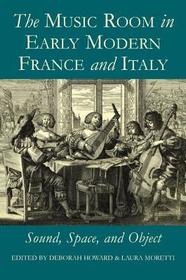
The Music Room in Early Modern France and Italy
Sound, Space and Object
Series: Proceedings of the British Academy; 176;
- Publisher's listprice GBP 70.00
-
31 605 Ft (30 100 Ft + 5% VAT)
The price is estimated because at the time of ordering we do not know what conversion rates will apply to HUF / product currency when the book arrives. In case HUF is weaker, the price increases slightly, in case HUF is stronger, the price goes lower slightly.
- Discount 10% (cc. 3 161 Ft off)
- Discounted price 28 445 Ft (27 090 Ft + 5% VAT)
Subcribe now and take benefit of a favourable price.
Subscribe
31 605 Ft

Availability
Estimated delivery time: In stock at the publisher, but not at Prospero's office. Delivery time approx. 3-5 weeks.
Not in stock at Prospero.
Why don't you give exact delivery time?
Delivery time is estimated on our previous experiences. We give estimations only, because we order from outside Hungary, and the delivery time mainly depends on how quickly the publisher supplies the book. Faster or slower deliveries both happen, but we do our best to supply as quickly as possible.
Product details:
- Publisher The British Academy
- Date of Publication 14 June 2012
- ISBN 9780197265055
- Binding Hardback
- No. of pages300 pages
- Size 241x165x10 mm
- Weight 792 g
- Language English
- Illustrations 78 half-tones and colour photos 0
Categories
Short description:
This interdisciplinary book investigates spaces for music-making in Early Modern France and Italy. Spaces specifically designed for music began to appear in private dwellings. While elite music-making became more specialised through the employment of paid musicians, music printing allowed new compositions to be diffused down the social scale.
Long description:
This interdisciplinary book investigates the use of secular space for music making in Early Modern France and Italy. The fact that many artists of the time also had musical skills underlines the close relationship between music and the visual arts. This era is remarkable for the growing importance of music in domestic life, ranging from elaborate court festivities to family recreation. In parallel with the emergence of the theatre as a separate building type, music-making in elite circles became more specialised through the employment of paid musicians, as opposed to amateur participation by the inhabitants and their guests. Meanwhile, however, music printing and the mass-production of instruments, especially lutes, allowed music-making to diffuse down the social scale.
We see how spaces specifically designed for music began to appear in private dwellings, while existing rooms became adapted for the purpose. At first, the number of rooms specifically identifiable as 'music rooms' was very small, but gradually over the following 150 years, specialised music rooms began to appear in larger residences in both France and Italy. A major theme is the relationship between the size and purpose of the room and the kinds of music performed - depending on the size, portability and loudness of different instruments; the types of music suited to spaces of different dimensions; the role of music in dancing and banqueting; and the positions of players and listeners. Musical instruments were often elaborately decorated to become works of art in their own right.
This is an excellent and much-needed book. More
Table of Contents:
- Introduction: Music-making in Residenctiontial Space
- 1. The Visual Dimension
- 1: Patricia Fortini Brown: Seduction and Spirituality: The Ambiguous Roles of Music in Venetian Art
- 2: Flora Dennis: When is a Room a Music Room? Sounds, Spaces, and Objects in Non-courtly Italian Interiors
- 3: Tracy E. Cooper: The Place of Music in the Artist's Home
- 2. The Spatial Dimension
- 4: Sophie Pickford: Music in the French Domestic Interior (1500-1600)
- 5: Deborah Howard: The Role of Music in the Venetian Home in the Cinquecento
- 6: Rebecca Norris: Women on the Edge: The 'Saletta delle Dame' of the Palazzo Salvadego in Brescia
- 3. The Aural Dimension
- 7: Mimmo Peruffo: Balance on the Lute: The Role of the Strings
- 8: Michael Lowe: The Lute: An Intrument for All Seasons
- 9: Raf Orlowski: Assessing the Acoustic Performance of Small Music Rooms: A Short Introduction
- 4. The Intellectual Dimension
- 10: Giovanni Zanovello: 'With tempered notes, in the green hills and among rivers': Music, Learning, and the Symbolic Space of Recreation in the Manuscript Modena, Biblioteca Estense, Universitaria A.F.9.9
- 11: Guido Beltramini: Spaces for Music in Sixteenth-Century Paduan Noble Courts
- 12: Michael Markham: Caccini's Stages: Identity and Performance Space in the Late Cinquecento Courts
- 5. Courtly Contexts
- 13: Laura Moretti: Spaces for Musical Performance in the Este Court in Ferrara (c 1440-1540)
- 14: Iain Fenlon: Music Rooms in the Ducal Palace in Mantua: From Andrea Mantegna to Giovan Battista Bertani
- 15: Tessa Murdoch: Queen Christina of Sweden as a Patron of Music in Rome in the Mid-Seventeenth Century
- 6. The Development of Purpose-Built Spaces for Music
- 16: Davide Bonsi: The Acoustic Analysis of Palladio's Teatro Olimpico, Vicenza
- 17: Tarek Barreda: Music at Home: Spaces for Music in French Seventeenth-Century Residential Architecture
- 18: Arnaldo Morelli: Spaces for Musical Performance in Seventeenth-Century Roman Residences

