

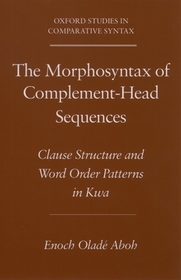
The Morphosyntax of Complement-Head Sequences
Clause Structure and Word Order Patterns in Kwa
Series: Oxford Studies in Comparative Syntax;
- Publisher's listprice GBP 142.50
-
64 338 Ft (61 275 Ft + 5% VAT)
The price is estimated because at the time of ordering we do not know what conversion rates will apply to HUF / product currency when the book arrives. In case HUF is weaker, the price increases slightly, in case HUF is stronger, the price goes lower slightly.
- Discount 10% (cc. 6 433 Ft off)
- Discounted price 57 905 Ft (55 148 Ft + 5% VAT)
Subcribe now and take benefit of a favourable price.
Subscribe
64 338 Ft

Availability
printed on demand
Why don't you give exact delivery time?
Delivery time is estimated on our previous experiences. We give estimations only, because we order from outside Hungary, and the delivery time mainly depends on how quickly the publisher supplies the book. Faster or slower deliveries both happen, but we do our best to supply as quickly as possible.
Product details:
- Publisher OUP Oxford
- Date of Publication 8 January 2004
- ISBN 9780195159905
- Binding Paperback
- No. of pages392 pages
- Size 162x240x26 mm
- Weight 558 g
- Language English 0
Categories
Short description:
This is the first book on the syntax of the Niger-Congo language family, which includes most of the languages of sub-Saharan Africa. Aboh, who is a native speaker of one of the languages (Gungbe) discussed, analyses different aspects of the syntax of the Kwa language group. Aboh also suggests how grammatical pictures for these languages can shed some light on Universal Grammar in general.
MoreLong description:
This is the first book on the syntax of the Niger-Congo language family, which includes most of the languages of sub-Saharan Africa. Aboh, who is a native speaker of one of the languages (Gungbe) discussed, analyzes different aspects of the syntax of the "Kwa" language group. Aboh also suggests how grammatical pictures for these languages can shed some light on Universal Grammar in general.
Aboh argues his positions with care and illustrates with abundant data - two virtues that should make this study of interest and use also for nonminimalist readers.

