

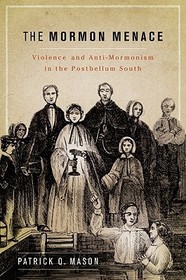
The Mormon Menace
Violence and Anti-Mormonism in the Postbellum South
- Publisher's listprice GBP 45.99
-
20 764 Ft (19 775 Ft + 5% VAT)
The price is estimated because at the time of ordering we do not know what conversion rates will apply to HUF / product currency when the book arrives. In case HUF is weaker, the price increases slightly, in case HUF is stronger, the price goes lower slightly.
- Discount 10% (cc. 2 077 Ft off)
- Discounted price 18 687 Ft (17 798 Ft + 5% VAT)
Subcribe now and take benefit of a favourable price.
Subscribe
20 764 Ft

Availability
printed on demand
Why don't you give exact delivery time?
Delivery time is estimated on our previous experiences. We give estimations only, because we order from outside Hungary, and the delivery time mainly depends on how quickly the publisher supplies the book. Faster or slower deliveries both happen, but we do our best to supply as quickly as possible.
Product details:
- Publisher OUP USA
- Date of Publication 24 February 2011
- ISBN 9780199740024
- Binding Hardback
- No. of pages264 pages
- Size 236x155x25 mm
- Weight 476 g
- Language English 0
Categories
Short description:
In the late 1800s, Mormonism was vilified throughout the United States. A national campaign featuring politicians, church leaders, social reformers, the press, women's organizations, businessmen, and ordinary citizens sought to end the Latter-day Saint practice of polygamy and to extinguish the entire religion. Patrick Mason demonstrates that anti-Mormonism was one of the earliest grounds for reconciliation between North and South after the Civil War and Reconstruction. Southerners joined with northern reformers and Republicans to endorse the use of newly expanded federal power to vanquish the perceived threat to Christian marriage and the American republic.
MoreLong description:
''It incarnates every unclean beast of lust, guile, falsehood, murder, despotism and spiritual wickedness.'' So wrote a prominent Southern Baptist official in 1899, as he viewed with disgust what contemporary scholars have called the "quintessential American religion. " In the late nineteenth century, Mormonism was the most vilified homegrown American religion. A national campaign featuring politicians, church leaders, social reformers, the press, women's organizations, businessmen, and ordinary citizens sought to end the distinctive Latter-day Saint practice of polygamy, and, if necessary, to extinguish the entire religion.
Considering the movement against polygamy within American and southern history, Mason demonstrates how anti-Mormonism was one of the earliest grounds for reconciliation between North and South after the Civil War and Reconstruction. Southerners joined with northern reformers and Republicans to endorse the use of newly expanded federal power to vanquish the perceived threat to Christian marriage and the American republic.
Anti-Mormonism was a significant intellectual, legal, religious, and cultural phenomenon, but in the South it was also violent. While southerners were concerned about distinctive Mormon beliefs and political practices, they were most alarmed at the "invasion " of Mormon missionaries in their communities, and the prospect of their wives and daughters falling prey to polygamy. In order to defend their homes and their honor against this threat, southerners turned to legislation, religion, and, most dramatically, vigilante violence.
The Mormon Menace provides new insights onto some of the most important discussions of not only the late nineteenth century but also our own age, including debates over the nature and limits of religious freedom, the contest between the will of the people and the rule of law, and the role of citizens, churches, and the state in regulating and defining marriage.
. . . Patrick Mason has made a valuable contribution to the field of Mormon studies. The Mormon Menace is a fine illustration of just how successful contemporary scholarship on Mormon history has been in moving beyond older conceptual models focused primarily on Utah and the West. . . well researched and thoughtfully written.
Table of Contents:
- Introduction
- The Lustful Lout: The Murder of Joseph Standing
- Rumors, Religious Competition, and Community Violence: The Cane Creek Massacre
- This Congregation of Sensualists: Polygamy in the Southern Mind
- The Second Reconstruction: Southern Anti-Polygamy and the Limits of Religious Freedom
- The Mormon Monster: Political and Religious Aspects of Southern Anti-Mormonism
- Patterns and Context of Anti-Mormon Violence
- The Blood of Martyrs: Southern Anti-Mormonism and LDS Identity
- Religious Minorities and the Problem of Peculiar Peoplehood
Abbreviations Used in Notes
Notes

