

- Publisher's listprice GBP 25.99
-
11 734 Ft (11 175 Ft + 5% VAT)
The price is estimated because at the time of ordering we do not know what conversion rates will apply to HUF / product currency when the book arrives. In case HUF is weaker, the price increases slightly, in case HUF is stronger, the price goes lower slightly.
- Discount 10% (cc. 1 173 Ft off)
- Discounted price 10 560 Ft (10 058 Ft + 5% VAT)
Subcribe now and take benefit of a favourable price.
Subscribe
11 734 Ft

Availability
Uncertain availability. Please turn to our customer service.
Why don't you give exact delivery time?
Delivery time is estimated on our previous experiences. We give estimations only, because we order from outside Hungary, and the delivery time mainly depends on how quickly the publisher supplies the book. Faster or slower deliveries both happen, but we do our best to supply as quickly as possible.
Product details:
- Publisher OUP USA
- Date of Publication 29 November 2012
- ISBN 9780199897520
- Binding Hardback
- No. of pages288 pages
- Size 236x163x24 mm
- Weight 512 g
- Language English 0
Categories
Short description:
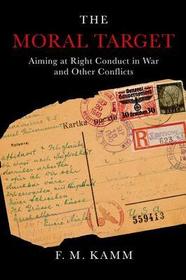
The Moral Target: Aiming at Right Conduct in War and Other Conflicts comprises essays that discuss aspects of war and other conflicts in the light of nonconsequentialist ethical theory. Topics include the relation between conditions that justify starting war and those that justify stopping it, the treatment of combatants and noncombatants in war, collaboration, justice after war and other conflicts, terrorism, resistance to communal injustice, and nuclear
deterrence.
Long description:
The Moral Target: Aiming at Right Conduct in War and Other Conflicts comprises essay that discuss aspects of war and other conflicts in the light of both nonconsequentialist ethical theory and the views of such theorists as Barbara Herman, Jeff McMahan, Avishai Margalit, and Michael Walzer. The first essay deals with the relation between states of affairs whose termination justifies war and states of affairs that once achieved should put an end to war. The
next few essays deal with conduct in war. They first consider the implications of general moral principles (including the Doctrine of Double Effect and Principle of Permissible Harm) for the permissibility of harm to combatants and noncombatants, and then whether factors unique to war should alter what is
permissible. In particular, if the context of war should affect the relative violability of different combatants and different noncombatants, if terror killing combatants and/or noncombatants should ever be permissible, and if there is liability to harm in virtue of belonging to a group. The fifth essay examines how recent discussions by nonconsequentialists about redirection of threats (as in the famous Trolley Problem) may illuminate the moral status of collaboration that took place with
Nazis during the Holocaust. What justice requires after conflict and how our ability to provide it affects the permissibility of starting war, is the next topic. Truth and reconciliation commissions and retribution post-conflict are discussed, and whether harm to civilians stemming from such procedures
(and how the harm arises) bear on the permissibility of instituting the procedures. The three concluding essays deal with moral aspects of conflicts outside of standard war, including those involving the threat of terrorism, resistance to communal injustice (for example, in the case of the Taliban women), and the use of nuclear weapons for deterrence.
excellent
Table of Contents:
Introduction
1. Making War and Its Continuation Unjust
2. Conduct in War: Justifications for Killing Noncombatants in War
3. Conduct in War: Failures of Just War Theory
4: Conduct in War: The Morality of Killing in War
5: Collaboration and with the Enemy: Harming Some to Save Others from the Nazis
6. Post Conflict: Moral Improvisation and New Obligations
7. Post Conflict: Just Post Bello, Proportionality, and Rehabilitation
8. Terrorism and Several Moral Distinctions
9. Self Defense, Resistance, and Suicide: The Taliban Women
10. Nuclear Deterrence and Noncombatants

