

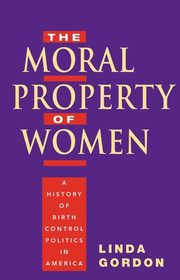
The Moral Property of Women
A History of Birth Control Politics in America
- Publisher's listprice GBP 28.99
-
13 088 Ft (12 465 Ft + 5% VAT)
The price is estimated because at the time of ordering we do not know what conversion rates will apply to HUF / product currency when the book arrives. In case HUF is weaker, the price increases slightly, in case HUF is stronger, the price goes lower slightly.
- Discount 10% (cc. 1 309 Ft off)
- Discounted price 11 779 Ft (11 219 Ft + 5% VAT)
Subcribe now and take benefit of a favourable price.
Subscribe
13 088 Ft

Availability
Out of print
Why don't you give exact delivery time?
Delivery time is estimated on our previous experiences. We give estimations only, because we order from outside Hungary, and the delivery time mainly depends on how quickly the publisher supplies the book. Faster or slower deliveries both happen, but we do our best to supply as quickly as possible.
Product details:
- Publisher University of Illinois Press
- Date of Publication 6 November 2002
- Number of Volumes Hardcover
- ISBN 9780252027642
- Binding Hardback
- No. of pages464 pages
- Size 235x153 mm
- Language English 0
Categories
Short description:
Choice Magazine's Outstanding Academic Books for 2004The only book to cover the entire history of birth control and the intense controversies about reproduction rights that have raged in the United States for more than 150 years, The Moral Property of Women is a thoroughly updated and revised version of the award-winning historian Linda Gordon's classic history Woman's Body, Woman's Right, originally published in 1976.
Arguing that reproduction control has always been central to women's status, The Moral Property of Women shows how opposition to it has long been part of the conservative opposition to gender equality. From its roots in folk medicine and in a campaign so broad it constituted a grassroots social movement at some points in history, to its legitimization through public policy, the widespread acceptance of birth control has involved a major reorientation of sexual values.
Gordon puts today's reproduction control controversies--foreign aid for family planning, the abortion debates, teenage pregnancy and childbearing, stem-cell research--into historical perspective and shows how the campaign to legalize abortion is part of a 150-year-old struggle over reproductive rights, a struggle that has followed a circuitous path. Beginning with the "folk medicine" of birth control, Gordon discusses how the backlash against the first women's rights movement of the 1800s prohibited both abortion and contraception about 130 years ago. She traces the campaign for legal reproduction control from the 1870s to the present and argues that attitudes toward birth control have been inseparable from family values, especially standards about sexuality and gender equality.
Highlighting both leaders and followers in the struggle, The Moral Property of Women chronicles the contributions of well-known reproduction control pioneers such as Elizabeth Cady Stanton, Margaret Sanger, and Emma Goldman, as well as lesser- known campaigners including the utopian socialist Robert Dale Owen, the three doctors Foote--Edward Bliss Foote, Edward Bond Foote, and Mary Bond Foote--the civil libertarian Mary Ware Dennett, and the daring Jane project of the 1970s, in which Chicago women's liberation activists performed illegal abortions.
Long description:
Choice Magazine's Outstanding Academic Books for 2004The only book to cover the entire history of birth control and the intense controversies about reproduction rights that have raged in the United States for more than 150 years, The Moral Property of Women is a thoroughly updated and revised version of the award-winning historian Linda Gordon's classic history Woman's Body, Woman's Right, originally published in 1976.
Arguing that reproduction control has always been central to women's status, The Moral Property of Women shows how opposition to it has long been part of the conservative opposition to gender equality. From its roots in folk medicine and in a campaign so broad it constituted a grassroots social movement at some points in history, to its legitimization through public policy, the widespread acceptance of birth control has involved a major reorientation of sexual values.
Gordon puts today's reproduction control controversies--foreign aid for family planning, the abortion debates, teenage pregnancy and childbearing, stem-cell research--into historical perspective and shows how the campaign to legalize abortion is part of a 150-year-old struggle over reproductive rights, a struggle that has followed a circuitous path. Beginning with the "folk medicine" of birth control, Gordon discusses how the backlash against the first women's rights movement of the 1800s prohibited both abortion and contraception about 130 years ago. She traces the campaign for legal reproduction control from the 1870s to the present and argues that attitudes toward birth control have been inseparable from family values, especially standards about sexuality and gender equality.
Highlighting both leaders and followers in the struggle, The Moral Property of Women chronicles the contributions of well-known reproduction control pioneers such as Elizabeth Cady Stanton, Margaret Sanger, and Emma Goldman, as well as lesser- known campaigners including the utopian socialist Robert Dale Owen, the three doctors Foote--Edward Bliss Foote, Edward Bond Foote, and Mary Bond Foote--the civil libertarian Mary Ware Dennett, and the daring Jane project of the 1970s, in which Chicago women's liberation activists performed illegal abortions.
"A major contribution to the history that feminists must know if we are not to repeat it." -- Adrienne Rich

