

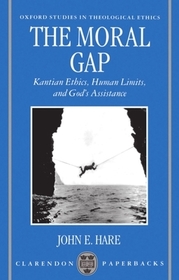
The Moral Gap
Kantian Ethics, Human Limits, and God's Assistance
Series: Oxford Studies in Theological Ethics;
- Publisher's listprice GBP 63.00
-
28 444 Ft (27 090 Ft + 5% VAT)
The price is estimated because at the time of ordering we do not know what conversion rates will apply to HUF / product currency when the book arrives. In case HUF is weaker, the price increases slightly, in case HUF is stronger, the price goes lower slightly.
- Discount 10% (cc. 2 844 Ft off)
- Discounted price 25 600 Ft (24 381 Ft + 5% VAT)
Subcribe now and take benefit of a favourable price.
Subscribe
28 444 Ft

Availability
printed on demand
Why don't you give exact delivery time?
Delivery time is estimated on our previous experiences. We give estimations only, because we order from outside Hungary, and the delivery time mainly depends on how quickly the publisher supplies the book. Faster or slower deliveries both happen, but we do our best to supply as quickly as possible.
Product details:
- Publisher Clarendon Press
- Date of Publication 1 May 1997
- ISBN 9780198269571
- Binding Paperback
- No. of pages302 pages
- Size 215x137x18 mm
- Weight 432 g
- Language English 0
Categories
Short description:
Is morality too hard for human beings? Kant said it was, except with God's assistance. Contemporary moral philosophers have usually discussed the question without reference to Christian doctrine. They have either diminished the moral demand or exaggerated human moral capacity, or tried to find a substitute in nature for God's assistance. This book looks at these philosophers from Kierkegaard to Swinburne and the author's own father, R.M. Hare, and the alternative in Christianity.
MoreLong description:
This book is about the gap between the moral demand on us and our natural capacities to meet it. John Hare starts with Kants statement of the moral demand and his acknowledgement of this gap. Hare then analyses Kants use of the resources of the Christian tradition to make sense of this gap, especially the notions of revelation, providence, and Gods grace. Kant reflects the traditional way of making sense of this gap, which is to invoke Gods assistance in bridging it. Hare goes on to examine various contemporary philosophers who do not use these resources. He considers three main strategies: exaggerating our natural capacities, diminishing the moral demand, and finding some naturalistic substitute for Gods assistance. He argues that these strategies do not work, and that we are therefore left with the gap and with the problem that it is unreasonable to demand of ourselves a standard which we cannot reach. In the final section of the book, Hare looks in more detail at the Christian doctrines of atonement, justification, and sanctification. He discusses Kierkegaards account of the relation between the ethical life and the Christian life, and ends by considering human forgiveness, and the ways in which Gods forgiveness is both like and unlike our forgiveness of each other.
The book is intended for those interested in both ethical theory and Christian theology.
an impressive book
Table of Contents:
Introduction
Part I: Kantian Ethics
Kant and the Moral Demand
God's Suppplement
Moral Faith
Part II: Human Limits
Puffing up the Capacity
Reducing the Demand
Substitutes for God's Assistance
Part III: God's Assistance
Repentance
Forgiveness
God's Assistance
Bibliography
Index of Biblical Passages
General Index

