

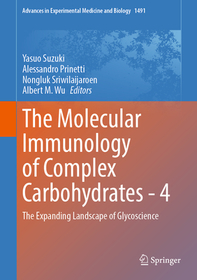
The Molecular Immunology of Complex Carbohydrates - 4
The Expanding Landscape of Glycoscience
Series: Advances in Experimental Medicine and Biology;
-
GET 12% OFF
- Publisher's listprice EUR 267.49
-
110 941 Ft (105 658 Ft + 5% VAT)
The price is estimated because at the time of ordering we do not know what conversion rates will apply to HUF / product currency when the book arrives. In case HUF is weaker, the price increases slightly, in case HUF is stronger, the price goes lower slightly.
- Discount 12% (cc. 13 313 Ft off)
- Discounted price 97 628 Ft (92 979 Ft + 5% VAT)
97 628 Ft

Availability
Not yet published.
Why don't you give exact delivery time?
Delivery time is estimated on our previous experiences. We give estimations only, because we order from outside Hungary, and the delivery time mainly depends on how quickly the publisher supplies the book. Faster or slower deliveries both happen, but we do our best to supply as quickly as possible.
Product details:
- Publisher Springer Nature Switzerland
- Date of Publication 2 April 2026
- ISBN 9783032041524
- Binding Hardback
- No. of pages662 pages
- Size 254x178 mm
- Language English
- Illustrations XIX, 662 p. 214 illus., 175 illus. in color. 700
Categories
Long description:
"
This book covers the expanding landscape of glycoscience over the past decade from the earlier books titled “The Molecular Immunology of Complex Carbohydrates 1, 2, and 3”. It aims to provide systematic and comprehensive reviews of the glycoscience field. In addition to the diverse roles of glycans in the immune system, this volume broadens its scope to encompass (i) human glycoscience across multiple systems of the human body—most notably the nervous system, influencing both physiological processes like neuronal axon generation and pathological conditions like Alzheimer's disease, (ii) microbial glycoscience, and (iii) environmental glycoscience.
Moreover, significant attention is given to the current and emerging (iv) applications of glycoscience in biotechnology and chemical technology.
Comprised of 36 chapters and authored by 89 internationally recognized experts in addition to one author, who worked on the proofs of his late mother, this book provides a wide-ranging and in-depth exploration of glycan biosynthesis and structure, extending to their functional significance in various human biological systems and microbial physiology. It offers detailed insights into complex biological interactions—not only cell–cell recognition and communication, but also the dynamic relationships between host and microbe, human and food or pollen, and even cross-reactivities between foods and pollens. This book highlights modern biotechnology and chemical innovation in glycan-based and glycan-binding protein (lectin)-based syntheses and applications of glycans and lectins in detection, diagnosis, prevention, and therapy of physiological and pathogenic diseases. Cutting-edge examples of glycan- and lectin-based strategies in vaccine development and biomedical research are also thoroughly presented.
Enriched with numerous explanatory illustrations and extensively referenced with foundational and recent literatures, this work constitutes a valuable resource for students, early-career scientists, researchers, clinicians, and specialists engaged in the life sciences and medicine.
" MoreTable of Contents:
1.Serendipitous discoveries in biomedical sciences (revisited).- 2.Neuronal axon generation/regeneration regulated by sulfated glycans.- 3.Roles of Core Fucosylation in Neuroinflammation and its Possibility for Application.- 4.Unique expression and glycosylation of amyloid precursor protein in Alzheimer’s disease.- 5.Relationship between regulation of polysialic acid expression and brain disease.- 6.Biosynthesis and regulation of laminin-binding O-mannosyl glycans related to muscular dystrophy.- 7.New sialic acid-binding site of SIGLEC-7.- 8.Glycan structures of human immunoglobulins and their roles.- 9.Elucidation of the roles of CD22 cis-ligands in B lymphocyte development and signaling using genetic and chemical tools.- 10.Functions of Sulfatide in The Nervous, Immune, and Urinary Systems.- 11.The Historiography of Galactose and its Recognition by Galectins.- 12.Biological significance of C-domain of the vertebrate CMP-sialic acid synthetases.- 13.Lysosomal Neuramnidase1 NEU1, Its Unique Molecular Characters, and Therapeutic Approaches for Deficiencies.- 14.Sulfated glycosaminoglycans in inflammation.- 15.Impacts of Globo H ceramide on tumor microenvironment.- 16.Cytosolic peptide: N-glycanase (NGLY1) -from basic biology to genetic disorder, NGLY1 deficiency.- 17.Sialidase activity imaging of different organs with BTP3-Neu5Ac.- 18.Glycan Markers of Human Pluripotent Stem Cells.- 19.Chemistry and biology of mycobacterial glycolipids.- 20.Glycoconjugate vaccines against nosocomial Klebsiella pneumoniae infections.- 21.Nechama Gilboa-Garber’s 55−Year Contribution to Glycobiology.- 22.Applications of pseudoviruses bearing glycoproteins of SARS-CoV-2 and influenza virus.- 23.Fluorescence imaging of viral sialidase activity using a fluorogenic probe.- 24.Influenza Virus Neuraminidase Glycoprotein, Its Inhibitors, and Their Resistance.- 25.Pharmacophores of influenza virus PA endonuclease inhibitors.- 26.The biological role of enveloped virus glycosylation and its interactions with anti-viral lectins.- 27.Roles of Glycoconjugates and Mucinases from Carcinogenic Liver Fluke, Opisthorchis viverrini, in Host-Parasite Interactions.- 28.N-glycans of pollen allergens and plant food allergens and synthesis of neoglycopolymer for analyzing the immunological activities of antigenic N-glycans.- 29.The sizes and shapes of glycan-presenting particles determine IL-12 production from mononuclear phagocytes via a glycan-dependent phagocytic process.- 30.Carbohydrate-Binding Mechanism and Therapeutic Potential of Lectin Mimics.- 31.Immunotherapeutic strategies targeting GD2-expressing malignancies.- 32.Glycan remodeling technologies for enhancing antibody function.- 33.Chemical synthesis of homogeneous glycoproteins for the elucidation of glycan functions.- 34.Synthetic Strategies and Immunological Evaluation of C-Linked α-Galactosylceramide Analogs.- 35.Synthesis and application of glycopolymers having sialoglycosides.- 36.Glycan-Based Targeting Technology and Its Application in Therapeutic In Vivo Synthetic Chemistry.
More
