

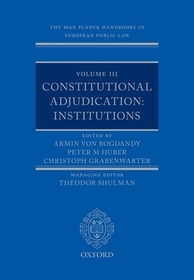
The Max Planck Handbooks in European Public Law
Volume III: Constitutional Adjudication: Institutions
Series: Max Planck Handbooks in European Public Law;
- Publisher's listprice GBP 275.00
-
124 162 Ft (118 250 Ft + 5% VAT)
The price is estimated because at the time of ordering we do not know what conversion rates will apply to HUF / product currency when the book arrives. In case HUF is weaker, the price increases slightly, in case HUF is stronger, the price goes lower slightly.
- Discount 20% (cc. 24 832 Ft off)
- Discounted price 99 330 Ft (94 600 Ft + 5% VAT)
- Discount is valid until: 30 June 2026
Subcribe now and take benefit of a favourable price.
Subscribe
124 162 Ft

Availability
Estimated delivery time: In stock at the publisher, but not at Prospero's office. Delivery time approx. 3-5 weeks.
Not in stock at Prospero.
Why don't you give exact delivery time?
Delivery time is estimated on our previous experiences. We give estimations only, because we order from outside Hungary, and the delivery time mainly depends on how quickly the publisher supplies the book. Faster or slower deliveries both happen, but we do our best to supply as quickly as possible.
Product details:
- Publisher OUP Oxford
- Date of Publication 12 March 2020
- ISBN 9780198726418
- Binding Hardback
- No. of pages976 pages
- Size 252x176x57 mm
- Weight 1822 g
- Language English 30
Categories
Short description:
This series analyses the public law of the European legal space, which encompasses the law of the EU, the European Convention on Human Rights, and the domestic public laws of European states. This volume analyses the history, organization, and procedure of constitutional adjudication and outlines the historical process and current outlook.
MoreLong description:
The Max Planck Handbooks in European Public Law describe and analyse public law of the European legal space, an area that encompasses not only the law of the European Union but also the European Convention on Human Rights and, importantly, the domestic public laws of European states. Recognizing that the ongoing vertical and horizontal processes of European integration make legal comparison the task of our time for both scholars and practitioners, the series aims to foster the development of a specifically European legal pluralism and to contribute to the legitimacy and efficiency of European public law.
The first volume of the series began this enterprise with an appraisal of the evolution of the state and its administration, offering both cross-cutting contributions and specific country reports. The third volume (the second in chronological terms) continues this approach with an in-depth appraisal of constitutional adjudication in various and diverse European countries. Fourteen country reports and two cross-cutting contributions investigate the antecedents, foundations, organization, procedure, and outlook of constitutional adjudicators throughout the Continent. They include countries with powerful constitutional courts, jurisdictions with traditional supreme courts, and states with small institutions and limited ex ante review. In keeping with the focus on a diverse but unified legal space, each report also details how its institution fits into the broader association of constitutional courts that, through dialogue and conflict, brings to fruition the European legal space. Together, the chapters of this volume provide a strong and diverse foundation for this dialogue to flourish.
Table of Contents:
Constitutional Adjudication in the European Legal Space
The Austrian Constitutional Court
The Belgian Constitutional Court
The Constitutional Court of Czechia
Constitutional Review in Finland
1. Constitutional Justice in France
1. The German Federal Constitutional Court
The Constitutional Court of Hungary
The Italian Constitutional Court
The Constitutional Court of the Republic of Latvia
Constitutional Adjudication in the Netherlands
The Polish Constitutional Tribunal
The Portuguese Constitutional Court
The Spanish Constitutional Tribunal
Constitutional Adjudication in Switzerland
The Influence of the United States Supreme Sourt on Judicial Review in Europe

