

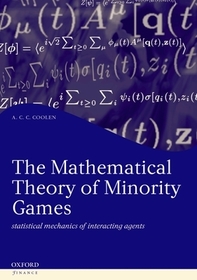
The Mathematical Theory of Minority Games
Statistical mechanics of interacting agents
Series: Oxford Finance Series;
- Publisher's listprice GBP 120.00
-
54 180 Ft (51 600 Ft + 5% VAT)
The price is estimated because at the time of ordering we do not know what conversion rates will apply to HUF / product currency when the book arrives. In case HUF is weaker, the price increases slightly, in case HUF is stronger, the price goes lower slightly.
- Discount 10% (cc. 5 418 Ft off)
- Discounted price 48 762 Ft (46 440 Ft + 5% VAT)
Subcribe now and take benefit of a favourable price.
Subscribe
54 180 Ft

Availability
printed on demand
Why don't you give exact delivery time?
Delivery time is estimated on our previous experiences. We give estimations only, because we order from outside Hungary, and the delivery time mainly depends on how quickly the publisher supplies the book. Faster or slower deliveries both happen, but we do our best to supply as quickly as possible.
Product details:
- Publisher OUP Oxford
- Date of Publication 6 January 2005
- ISBN 9780198520801
- Binding Hardback
- No. of pages338 pages
- Size 247x174x23 mm
- Weight 817 g
- Language English
- Illustrations numerous figures 0
Categories
Short description:
Aimed at researchers and students in physics, mathematics and economics, as well as financial practitioners,
this text describes the mathematical theory of Minority Games from a statistical mechanics viewpoint. It provides a detailed and explicit introduction to the advanced mathematical analysis of these models, describes the potential and restrictions of physical methods in solving agent based market models, and outlines how different mathematical approaches are related.
Long description:
Minority games are simple mathematical models initially designed to understand the co-operative phenomena observed in markets.
Their core ingredients are large numbers of interacting decision-making agents, each aiming for personal gain in an artificial `market' by trying to anticipate (on the basis of incomplete information, and with an element of irrationality) the actions of others. Gain is made by those who subsequently find themselves in the minority group, e.g. those who end up buying when most wish to sell or vice versa.
Aimed at researchers and students in physics, mathematics and economics this text describes the mathematical theory of Minority Games from a statistical mechanics viewpoint. It provides a detailed and explicit introduction to the advanced mathematical analysis of these models, describes the potential and restrictions of physical methods in solving agent based market models, and outlines how different mathematical approaches are related.
Table of Contents:
Introduction
Preparing the stage for statistical mechanics
Pseudo-equilibrium replica analysis
Dynamics of the batch MG with fake memory
Dynamics of the on-line MG with fake memory
The overall bid distribution
MG versions with new types of phase transitions
Dynamics of MGs with true market history
Variations and generalizations
Notes
Appendices
Simple mathematical conventions and tools
Integrals
Moments of random matrices
Expansion of bid sign recurrence probabilities
Combinatorics in history frequency moments
Details of numerical simulation experiments
References
Index

