

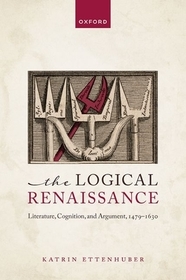
The Logical Renaissance
Literature, Cognition, and Argument, 1479-1630
- Publisher's listprice GBP 87.00
-
39 280 Ft (37 410 Ft + 5% VAT)
The price is estimated because at the time of ordering we do not know what conversion rates will apply to HUF / product currency when the book arrives. In case HUF is weaker, the price increases slightly, in case HUF is stronger, the price goes lower slightly.
- Discount 10% (cc. 3 928 Ft off)
- Discounted price 35 352 Ft (33 669 Ft + 5% VAT)
Subcribe now and take benefit of a favourable price.
Subscribe
39 280 Ft

Availability
Estimated delivery time: In stock at the publisher, but not at Prospero's office. Delivery time approx. 3-5 weeks.
Not in stock at Prospero.
Why don't you give exact delivery time?
Delivery time is estimated on our previous experiences. We give estimations only, because we order from outside Hungary, and the delivery time mainly depends on how quickly the publisher supplies the book. Faster or slower deliveries both happen, but we do our best to supply as quickly as possible.
Product details:
- Publisher OUP Oxford
- Date of Publication 12 October 2023
- ISBN 9780198881186
- Binding Hardback
- No. of pages318 pages
- Size 240x163x22 mm
- Weight 610 g
- Language English 518
Categories
Short description:
This book charts for the first time the deep relationship between Renaissance literature and logic. Ettenhuber shows how the study of logic creatively inspired writers in the art of argument and reasoning, and offered frameworks for the discovery of literary material and advice on how to synthesise and present it.
MoreLong description:
The Logical Renaissance: Literature, Cognition, and Argument, 1479-1630 is the first substantial account of early modern English literature's deep but uncharted relationship with logic. The nature and functions of logic have been largely misunderstood in literary criticism of the period, where it is often seen as sterile and formalistic: either an overcomplex remnant of Medieval philosophy superseded by rhetoric, or part of a Ramist pedagogy so stripped back that it had little to offer in the way of creative inspiration.
Katrin Ettenhuber shows instead that early modern writers encountered in their study of logic a vibrantly practical art of argument and reasoning, which provided rich opportunities for imaginative engagement and artistic appropriation. The book opens with a clear and accessible introduction to the logical terms and concepts that will guide the discussion. It charts changes in logic education between the late fifteenth and early seventeenth centuries, before presenting a series of case studies that illustrate the creative applications of logic across a wide range of genres, including epic and lyric poetry, drama, and religious prose. The Logical Renaissance demonstrates, for the first time, logic's central role in the literary culture of early modern England.
This strikingly original account of the role of logic in early modern England reconfigures our understanding not just of the intellectual and educational contexts that shaped literary production but of how thinking is put to work in the very fabric and form of treatises, poems, sermons and plays from Thomas Wilson and Edmund Spenser to Lancelot Andrewes, Donne, Shakespeare and early Milton. Paradigm-shifting and authoritative, it challenges and lucidly advances much that we thought we knew about rhetoric and the Renaissance. Every reader interested in the period will learn from this foundational study and delight in the brilliance of its ideas.
Table of Contents:
Preface
Introduction
A Brief History of Early Modern Logic
Logic in Practice at Early Modern Cambridge: Young Milton
Sex and the Disjunctive Syllogism: The Logic of Love in Donne's Poetry
In Search of the Right Place: Sidney, Spenser, and the Dialectic of Invention
Andrewes, Spenser, and Reforming the Arts of Discourse
Truth Conditions: The Logic of Community in Early Modern Comedy
Conclusion
Introductory Reading List on Logic
Bibliography
Index

