

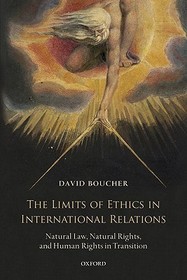
The Limits of Ethics in International Relations
Natural Law, Natural Rights, and Human Rights in Transition
- Publisher's listprice GBP 47.99
-
21 667 Ft (20 635 Ft + 5% VAT)
The price is estimated because at the time of ordering we do not know what conversion rates will apply to HUF / product currency when the book arrives. In case HUF is weaker, the price increases slightly, in case HUF is stronger, the price goes lower slightly.
- Discount 10% (cc. 2 167 Ft off)
- Discounted price 19 500 Ft (18 572 Ft + 5% VAT)
Subcribe now and take benefit of a favourable price.
Subscribe
21 667 Ft

Availability
printed on demand
Why don't you give exact delivery time?
Delivery time is estimated on our previous experiences. We give estimations only, because we order from outside Hungary, and the delivery time mainly depends on how quickly the publisher supplies the book. Faster or slower deliveries both happen, but we do our best to supply as quickly as possible.
Product details:
- Publisher OUP Oxford
- Date of Publication 5 May 2011
- ISBN 9780199691463
- Binding Paperback
- No. of pages432 pages
- Size 234x169x24 mm
- Weight 652 g
- Language English 0
Categories
Short description:
In his major new work, David Boucher surveys the history of thinking about human rights and shows that far from being seen as universal and emancipatory, they have almost always privileged certain groups in relation to others.
MoreLong description:
Ethical constraints on relations among individuals within and between societies have always reflected or invoked a higher authority than the caprices of human will. For over two thousand years natural law and natural rights were the constellations of ideas and presuppositions that fulfilled this role in the West, and exhibited far greater similarities than most commentators want to admit. Such ideas were the lens through which Europeans evaluated the rest of the world. In his major new book David Boucher rejects the view that natural rights constituted a secularization of natural law ideas by showing that most of the significant thinkers in the field, in their various ways, believed that reason leads you to the discovery of your obligations, while God provides the ground for discharging them. Furthermore, the book maintains that natural rights and human rights are far less closely related than is often asserted because natural rights can never be cast adrift from their religious foundations, whereas human rights, for the most part, have jettisoned the Christian metaphysics upon which both natural law and natural rights depended. Human rights theories, on the whole, present us with foundationless universal constraints on the actions of individuals, both domestically and internationally. Finally, one of the principal contentions of the book is that these purportedly universal rights and duties almost invariably turn out to be conditional, and upon close scrutiny end up being 'special' rights and privileges as the examples of multicultural encounters, slavery, racism, and women's rights demonstrate.
David Boucher's The Limits of Ethics in International Relations is the result of eleven years hard work. It shows a degree of ambition that is unfortunately rare in the current REF-driven environment, in terms of the period that it covers (from the Ancient Greeks to the present), the length of the book and the level of scholarship. The result is a deeply impressive achievement, containing a wealth of original and nuanced interpretation, especially in the chapters on modern political thought. The Limits of Ethics in International Relations is a remarkable book that develops an ambitious, intelligent, well-informed and original argument on a topic of fundamental contemporary importance.
Table of Contents:
Introduction
Classical Natural Law and the Law of Nations: The Greeks and The Romans
Christian Natural Law
Natural Law, The Law of Nations and the Transition to Natural Rights
Natural Rights and Social Exclusion: Cultural Encounters
Natural Rights: Descriptive and Prescriptive
Natural Rights and Their Critics
Slavery and Racism in Natural Law and Natural Rights
Nonsense Upon Stilts? Tocqueville, Idealism and the Expansion of the Moral Community
The Human Rights Culture and its Discontents
Modern Constitutive Theories of Human Rights
Human Rights and the Juridical Revolutions
Women and Human Rights
Conclusion
References

