

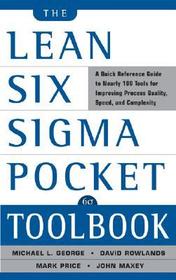
The Lean Six Sigma Pocket Toolbook: A Quick Reference Guide to Nearly 100 Tools for Improving Quality and Speed
A Quick Reference Guide to 70 Tools for Improving Quality and Speed
Series: CAREER (EXCLUDE VGM);
- Publisher's listprice GBP 18.99
-
8 573 Ft (8 165 Ft + 5% VAT)
The price is estimated because at the time of ordering we do not know what conversion rates will apply to HUF / product currency when the book arrives. In case HUF is weaker, the price increases slightly, in case HUF is stronger, the price goes lower slightly.
- Discount 10% (cc. 857 Ft off)
- Discounted price 7 716 Ft (7 349 Ft + 5% VAT)
Subcribe now and take benefit of a favourable price.
Subscribe
8 573 Ft

Availability
Estimated delivery time: In stock at the publisher, but not at Prospero's office. Delivery time approx. 3-5 weeks.
Not in stock at Prospero.
Why don't you give exact delivery time?
Delivery time is estimated on our previous experiences. We give estimations only, because we order from outside Hungary, and the delivery time mainly depends on how quickly the publisher supplies the book. Faster or slower deliveries both happen, but we do our best to supply as quickly as possible.
Product details:
- Publisher McGraw Hill
- Date of Publication 16 August 2004
- ISBN 9780071441193
- Binding Paperback
- No. of pages288 pages
- Size 200x129x20 mm
- Weight 279 g
- Language English 0
Categories
Long description:
Vital tools for implementing Lean Six Sigma--what they are, how they work, and which to use
The Lean Six Sigma Pocket Toolbook is today's most complete and results-based reference to the tools and concepts needed to understand, implement, and leverage Lean Six Sigma. The only guide that groups tools by purpose and use, this hands-on reference provides:
- Analyses of nearly 100 tools and methodologies--from DMAIC and Pull Systems to Control Charts and Pareto Charts
- Detailed explanations of each tool to help you know how, when, and why to use it for maximum efficacy
- Sections for each tool explaining how to create it, how to interpret what you find, and expert tips
Lean Six Sigma is today's leading technique to maximize production efficiency and maintain control over each step in the managerial process. With The Lean Six Sigma Pocket Toolbook, you'll discover how to propel your organization to new levels of competitive success--one tool at a time.
Vital tools for implementing Lean Six Sigma--what they are, how they work, and which to use
The Lean Six Sigma Pocket Toolbook is today's most complete and results-based reference to the tools and concepts needed to understand, implement, and leverage Lean Six Sigma. The only guide that groups tools by purpose and use, this hands-on reference provides:
- Analyses of nearly 100 tools and methodologies--from DMAIC and Pull Systems to Control Charts and Pareto Charts
- Detailed explanations of each tool to help you know how, when, and why to use it for maximum efficacy
- Sections for each tool explaining how to create it, how to interpret what you find, and expert tips
Lean Six Sigma is today's leading technique to maximize production efficiency and maintain control over each step in the managerial process. With The Lean Six Sigma Pocket Toolbook, you'll discover how to propel your organization to new levels of competitive success--one tool at a time.
MoreTable of Contents:
Chapter 1: Using DMAIC to Improve Speed, Quality, and Cost
Define
Measure
Analyze
Improve
Control
Kaizen DMAIC
Project selection
Chapter 2: Working With Ideas
Brainstorming
Affinity diagrams
Multivoting
Chapter 3: Value Stream Mapping and Process Flow Tools
Process mapping
Process observation
SIPOC
Process mapping steps
Transportation and spaghetti (workflow) diagrams
Swim-lane (deployment) flowcharts
Value stream maps (basic)
Flowchart and value stream symbols
Value-add (VA) vs. non-value-add (NVA) analysis
Time value maps
Value-add chart (task time or takt time chart)
Chapter 4: Voice of the Customer (VOC)
Customer segmentation
Sources of customer data
Collecting VOC: Interviews
Collecting VOC: Point-of-use observation
Collecting VOC: Focus groups
Collecting VOC: Surveys
Kano analysis
Developing critical-to-quality requirements
Chapter 5: Data Collection
Types of data
Input vs. output data
Data collection planning
Measurement selection matrix
Stratification factors
Operational definitions
Cautions on using existing data
Making a checksheet
Basic checksheets
Frequency plot checksheet
Traveler checksheet
Location checksheet
Sampling basics
Factors in sample selection
Stable process (and population) sampling
Formulas for determining minimum sample size (population or stable process)
Measurement System Analysis (MSA) and Gage R&R Overview
Gage R&R: Collecting the data
Interpreting Gage R&R Results
MSA: Evaluating bias
MSA: Evaluating stability
MSA: Evaluating discrimination
MSA for attribute/discrete data
Chapter 6: Descriptive Statistics and Data Displays
Statistical term conventions
Measures of central tendency (mean, median, mode)
Measures of spread (range, variance, standard deviation)
Boxplots
Frequency plot (histogram
Normal distribution
Non-normal distributions and the Central Limit Theorem
Chapter 7: Variation Analysis
Review of variation concepts
Time series plots (Run charts)
Run chart table
Control chart basics
Selecting a control chart
Control charts for continuous data
Subgrouping for continuous data
Control limit formulas for continuous data
Factors for Control Chart Formulas
Creating an ImR Chart
Creating X,R charts or X,S charts
Control charts for attribute data
Creating p-, np-, c-, and u-charts
Control limit formulas for attribute data
Assumptions for interpreting control charts
Interpreting control charts (Tests for Special Cause Variation)
Background on process capability calculations
Confusion in short-term vs. long-term process capability calculations
Calculating process capability
Chapter 8: Identifying and Verifying Causes
PART A: Identifying potential causes
Pareto charts
5 Whys
Cause-and-effect diagrams (fishbone or Ishikawa diagrams)
C&E Matrix
PART B: Tools for confirming causal effects
Stratified data charts
Testing quick fixes or obvious solutions
Scatter plots
Hypothesis testing overview
Confidence intervals
Type I and Type II errors, Confidence, Power, and p-values
Confidence intervals and sample size
t–test Overview
1-Sample t-test
2-Sample t-test
Overview of correlation
Correlation statistics (coefficients)
Regression overview
Simple linear regression
Multiple regression
ANOVA (ANalysis Of VAriance)
One-way ANOVA
Degrees of Freedom
ANOVA assumptions
Two-way ANOVA
Chi-Square test
Design of Experiments (DOE) notation and terms
Planning a designed experiment
DOE: Full-factorial vs.
Fractional-factorials (and notations)
Interpreting DOE results
Chapter 9: Reducing Lead Time and Non-Value-Add Cost
Basic Lean concepts
Metrics of time efficiency
Time Traps vs. Capacity Constraints
Identifying Time Traps and Capacity Constraints
5S Overview
Implementing 5S
Generic Pull System
Replenishment Pull Systems
Two-Bin Replenishment System
Computing minimum safe batch sizes
Four Step Rapid Setup Method
Adapting Four Step Rapid Setup for service processes
Total Productive Maintenance (TPM)
Mistake proofing & prevention (Poka-yoke)
Process balancing design principles
Work cell optimization
Visual Process Controls
Chapter 10: Complexity Value Stream Mapping and Complexity Analysis
Product/service family grid
Complexity Value Stream Map (CVSM)
Process Cycle Efficiency (PCE)
The Complexity Equation
Complexity matrix
PCE destruction calculations (for a Complexity Matrix)
Substructure analysis
“What-if” analyses with Complexity Matrix data
Chapter 11: Selecting and Testing Solutions
Sources of solution ideas
Benchmarking
Tips on solution selection
Developing and using evaluation criteria
Solution selection matrix
Pairwise ranking
Cost evaluation
Impact/effort matrix
Pugh matrix
Other evaluation techniques
Controls assessment matrix
Failure Modes and Effects Analysis (FMEA)
Pilot testing
Index

