

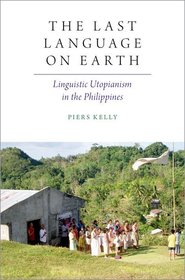
The Last Language on Earth
Linguistic Utopianism in the Philippines
Series: Oxford Studies in the Anthropology of Language;
- Publisher's listprice GBP 35.99
-
16 249 Ft (15 475 Ft + 5% VAT)
The price is estimated because at the time of ordering we do not know what conversion rates will apply to HUF / product currency when the book arrives. In case HUF is weaker, the price increases slightly, in case HUF is stronger, the price goes lower slightly.
- Discount 10% (cc. 1 625 Ft off)
- Discounted price 14 624 Ft (13 928 Ft + 5% VAT)
Subcribe now and take benefit of a favourable price.
Subscribe
16 249 Ft

Availability
Estimated delivery time: In stock at the publisher, but not at Prospero's office. Delivery time approx. 3-5 weeks.
Not in stock at Prospero.
Why don't you give exact delivery time?
Delivery time is estimated on our previous experiences. We give estimations only, because we order from outside Hungary, and the delivery time mainly depends on how quickly the publisher supplies the book. Faster or slower deliveries both happen, but we do our best to supply as quickly as possible.
Product details:
- Publisher OUP USA
- Date of Publication 25 May 2022
- ISBN 9780197509920
- Binding Paperback
- No. of pages328 pages
- Size 157x236x22 mm
- Weight 476 g
- Language English
- Illustrations 47 190
Categories
Short description:
The Last Language on Earth is the story of Eskayan, a constructed language from the Philippines. Unlike better-known invented languages such as Esperanto or Klingon, Eskayan has now been transmitted from generation to generation within its community for over a century and has come to be regarded by its speakers as the true indigenous language of the island of Bohol. The book considers the form of language itself as a point of departure, and analyzes the historical circumstances and ideological motivations that brought it into being and which continue to sustain it today.
MoreLong description:
The Last Language on Earth is an ethnographic history of the disputed Eskayan language, spoken today by an isolated upland community living on the island of Bohol in the southern Philippines. After Eskaya people were first 'discovered' in 1980, visitors described the group as a lost tribe preserving a unique language and writing system. Others argued that the Eskaya were merely members of a utopian rural cult who had invented their own language and script. Rather than adjudicating outsider polemics, this book engages directly with the language itself as well as the direct perspectives of those who use it today.
Through written and oral accounts, Eskaya people have represented their language as an ancestral creation derived from a human body. Reinforcing this traditional view, Piers Kelly's linguistic analysis shows how a complex new register was brought into being by fusing new vocabulary onto a modified local grammar. In a synthesis of linguistic, ethnographic, and historical evidence, a picture emerges of a coastal community that fled the ravages of the U.S. invasion of the island in 1901 in order to build a utopian society in the hills. Here they predicted that the world's languages would decline leaving Eskayan as the last language on earth. Marshalling anthropological theories of nationalism, authenticity, and language ideology, along with comparisons to similar events across highland Southeast Asia, Kelly offers a convincing account of this linguistic mystery and also shows its broader relevance to linguistic anthropology. Although the Eskayan situation is unusual, it has the power to illuminate the pivotal role that language plays in the pursuit of identity-building and political resistance.
This fascinating work of linguistic anthropology is based on both the author's fieldwork in the Philippines and his meticulous and wide-ranging research...this engaging monograph is likely to be of interest to students and scholars in the fields of anthropology, sociology, history, political science, linguistics, and Southeast Asian studies.
Table of Contents:
Maps
Acknowledgments
A Note on Terminology
Prologue
Chapter One: Introduction
What this Book is About
What Pinay Understood About Language
A Language Forgotten, a Language Foretold
PART I: Locating the Eskaya
Chapter Two: Language, Literacy and Revolt in the Southern Philippines
Pre-contact Visayan Literacy
The 'Problem' of Language Diversity in the Colonial and Early
Commonwealth periods (1593-1937)
Shamanic Rebellion and Indigenous Outlaws in Bohol (1621-1829)
Enter the Eskaya (1902-1937)
Chapter Three: Contact and Controversy
First Contact
Media
Institutional Tribehood
A Formal Alliance and a Lost Report
Eskaya Responses and a New Research Agenda
PART II: Language, Letters, Literature
Chapter Four: How Eskayan is Used Today
Bohol in the Visayas
Language use in Bohol
A picture of the Fieldsite
The Spoken and Sung Somains of Eskayan
The Written Domains of Eskayan and Ideologies of Writing
Chapter Five: The Writing System
Writing Eskayan Sounds
Numbers
Script
The Past and Future of Eskayan writing
Chapter Six: Words and Their Origins
Eskayan Grammar
The Lexicon
Sources of Inspiration
Pinay's Lexical Agenda
Chapter Seven: Eskaya Literature and Traditional Historiography
The Origins and Scope of Eskaya literature
Language History in Eskaya Literature: A Summary and Analysis
Discussion
PART III: Insurrection and Resurrection
Chapter Eight: From Pinay to Mariano Datahan (and Back Again)
Datahan and the Origins of the Biabas Encampment
The Return of Militant Cults 1902-1922
Accommodation with the US Regime ca. 1914-1937
Datahan's Final War and Posthumous legacy
Chapter Nine: Eskayan Revealed: A Scenario
The Rise of English in Bohol as a Catalyst for Eskayan
How Pinay's Language was Revealed
Prophecy, Prolepsis and Time Depth
Summary
Chapter Ten: Conclusion: The First Language and the Last Word
Imagining Indigeneity from Above: The View from the Helicopter
The Form of Eskayan and the Identity of Pinay
Imagining Indigeneity from Below: The View from the Village
Regional Parallels
The (Re)invention of Linguistic Tradition
The Future of Eskayan
References
Glossary of Eskayan Terms Used in this Volume
Index

