

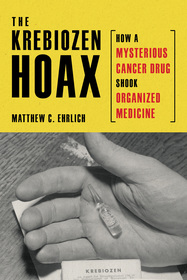
The Krebiozen Hoax
How a Mysterious Cancer Drug Shook Organized Medicine
- Publisher's listprice GBP 88.00
-
39 732 Ft (37 840 Ft + 5% VAT)
The price is estimated because at the time of ordering we do not know what conversion rates will apply to HUF / product currency when the book arrives. In case HUF is weaker, the price increases slightly, in case HUF is stronger, the price goes lower slightly.
- Discount 20% (cc. 7 946 Ft off)
- Discounted price 31 786 Ft (30 272 Ft + 5% VAT)
- Discount is valid until: 30 June 2026
Subcribe now and take benefit of a favourable price.
Subscribe
39 732 Ft

Availability
Estimated delivery time: In stock at the publisher, but not at Prospero's office. Delivery time approx. 3-5 weeks.
Not in stock at Prospero.
Why don't you give exact delivery time?
Delivery time is estimated on our previous experiences. We give estimations only, because we order from outside Hungary, and the delivery time mainly depends on how quickly the publisher supplies the book. Faster or slower deliveries both happen, but we do our best to supply as quickly as possible.
Product details:
- Edition number 1
- Publisher University of Illinois Press
- Date of Publication 20 August 2024
- Number of Volumes Hardback
- ISBN 9780252046018
- Binding Hardback
- No. of pages248 pages
- Size 229x152 mm
- Weight 454 g
- Language English
- Illustrations 15 black & white photographs 530
Categories
Long description:
The brainchild of an obscure Yugoslav physician, Krebiozen emerged in 1951 as an alleged cancer treatment. Andrew Ivy, a University of Illinois vice president and a famed physiologist dubbed “the conscience of U.S. science,” wholeheartedly embraced Krebiozen. Ivy’s impeccable credentials and reputation made the treatment seem like another midcentury medical miracle. But after years of controversy, the improbable saga ended with Krebiozen proved a sham, its inventor fleeing the country, and Ivy’s reputation and legacy in ruins.
Matthew C. Ehrlich’s history of Krebiozen tells a quintessential story of quackery. Though most experts dismissed the treatment, it found passionate public support not only among cancer patients but also people in good health. The treatment’s rise and fall took place against the backdrop of America’s never-ending suspicion of educational, scientific, and medical expertise. In addition, Ehrlich examines why people readily believe misinformation and struggle to maintain hope in the face of grave threats to well-being.
A dramatic account of fraud and misplaced trust, The Krebiozen Hoax shines a light on a forgotten medical scandal and its all-too-familiar relevance in the twenty-first century.
MoreTable of Contents:
Acknowledgments
Introduction: Cancer, Quackery, and Hope
- Substance X
- Krebiozen Does Not Exist
- Conspiracies and Circuses
- A Fair Test
- Nothing but Creatine
- The Emperor’s New Clothes
Conclusion: What Ever Happened to Doctor Ivy?
Notes
Index
More
